swiss researcher discovers creative use cases for e-Residency
A Swiss academic shows how digital ID use cases go far beyond startups, using e-Residency for everyday legal, academic, and cross-border life

Eleven years ago, Estonia introduced e-Residency, an innovative program that has in the ensuing years come to epitomize its image as a technology-happy, entrepreneurial digital nation. It was created out of a desire to share Estonia's ecosystem of digital services with the rest of the world, to bring more entrepreneurs to Estonia, and to raise awareness of the country.
There is also the EU advantage. By joining the program, people who obtain e-Residency after a thorough vetting can operate their companies from anywhere in the world using an Estonian state-issued digital identity card as if they were a European entity, which has spurred adoption.
The core statistics around the program often reflect not only the number of e-residents but also the companies they have created and the tax revenue they have generated for the state. As of October 2025, there were more than 131,700 card-holding Estonian e-residents who have founded, at least in part, more than 38,500 companies, for example. The top five citizenships held by current Estonian e-residents are Ukrainian, German, Spanish, Finnish, and French.
The Swiss connection
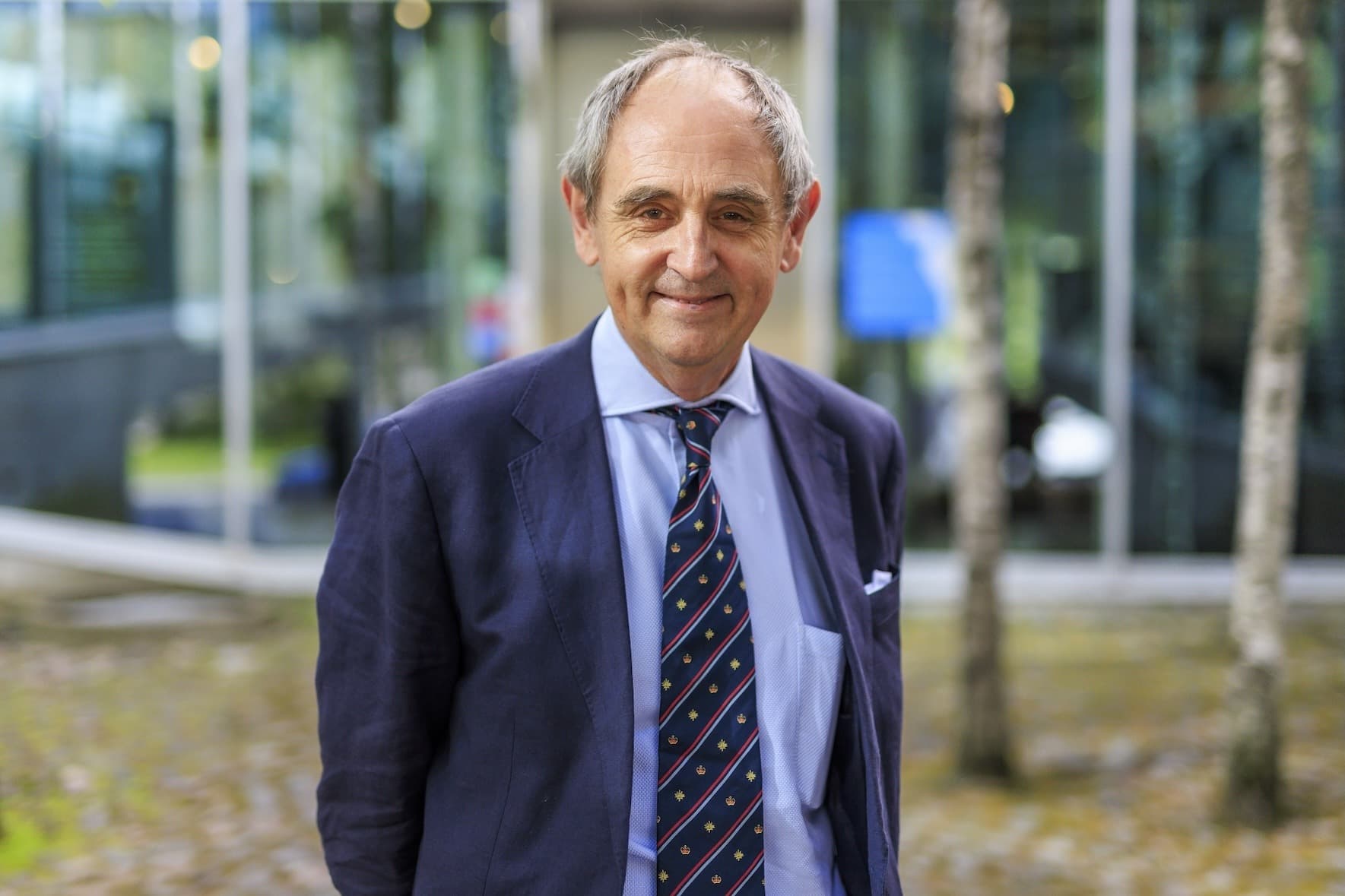
And then there is Switzerland, which is currently number 34 on the list and has produced 840 e-residents, one of whom, Yves Partschefeld, isn't a globe-hopping entrepreneurial digital nomad at all, but rather a stable family man and researcher who just happens to love Estonia.

In fact, Yves loves Estonia so much that he spends every summer there with his family, and undertakes some winter trips too. He has made it the focus of his academic career, and is a founding member of the Estonian Chamber of Commerce in Switzerland, where he is a board member.
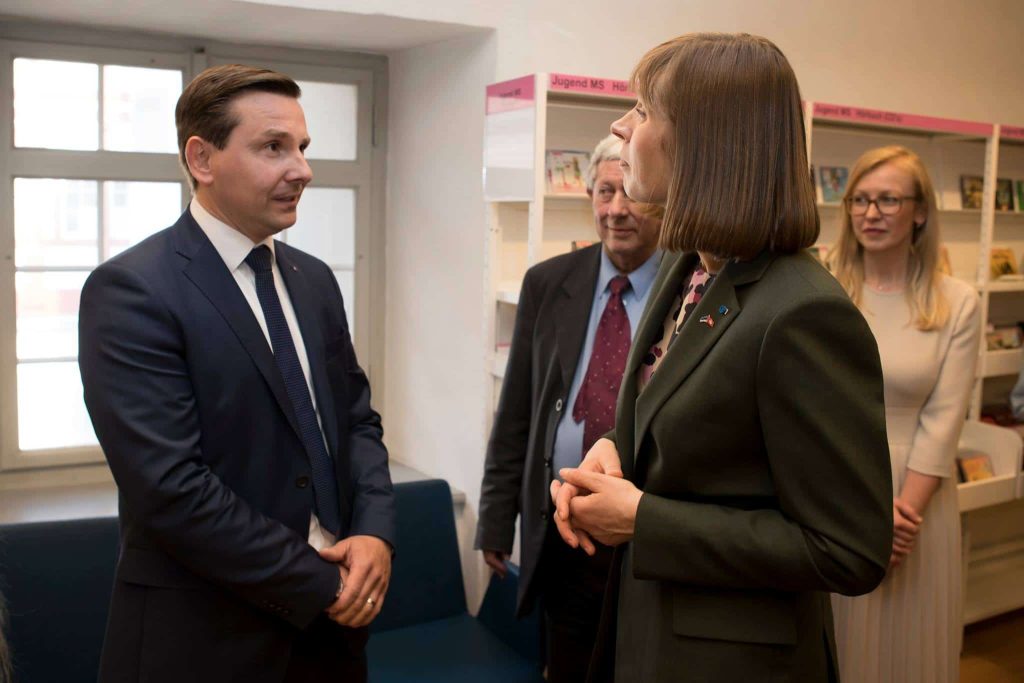
He even helped to set up an Estonian Children's and Youth Library collection in the Katharinen Bibliothek in St. Gallen, the city where he lives. For these and many other activities, Yves was the recipient of a Citizen Diplomat Appreciation Letter by the Ministry of Foreign Affairs of Estonia earlier this year, one of just a handful of such citizen diplomats to ever receive one.
"That came as a complete surprise," Yves says. "I found out through LinkedIn while attending a conference in Lucerne." For him, the letter was a proud moment. "Estonia doesn’t give out recognition lightly, so it meant a great deal," he says. It was the culmination of a lifelong interest in Estonia, one that not only involves Yves but his grandfather and a tale of wartime lost love.
The hearts of Europe
Yves is currently the executive director of the School of Humanities and Social Sciences at the University of St. Gallen, not far from the Austrian and German borders. St. Gallen is a smaller Swiss city with a population of about 79,000 and all the contours one might expect in the Alps.
"I walk to work every day," says Yves. "It takes about six minutes downhill in the morning and maybe eight or ten minutes uphill on the way back."
Located right in the heart of Europe, or at least one of its hearts, it seems an unlikely residence for someone who is so passionate about a small northern country like Estonia, which is about 2,300 kilometers away by car, but Yves has always had a special connection with the place.
Originally from Germany, he grew up hearing his grandfather's stories of being stationed in Estonia during the Second World War, where he mainly worked as a tailor, sewing up officers' uniforms and replacing buttons. Yves' grandfather had an Estonian sweetheart whom he planned to marry, but he was sent to the Soviet front, captured, and did not return to Germany until 1949.
His Estonian girlfriend in the meantime had escaped to Leipzig and stayed with Yves' grandfather's parents to wait for him, but that part of Germany came under Soviet military administration, and so she was registered as a Soviet citizen and probably sent back to the USSR.
"They never saw each other again," says Yves.
Because of the story, Estonia was always present in his life. "It was always a topic," he says. "Even when Estonia wasn’t on the map and was part of the Soviet Union, there was this sense that it existed somewhere, that it mattered." When his grandfather passed away in 2009, Yves inherited a whole bunch of keepsakes, including old black-and-white photos taken in Tallinn.
Lifelong friends
These almost cinematic tales of conflict and heartache were relayed to a young Yves by his grandfather in the 1990s at a time when he had a chance to take part in an exchange program.
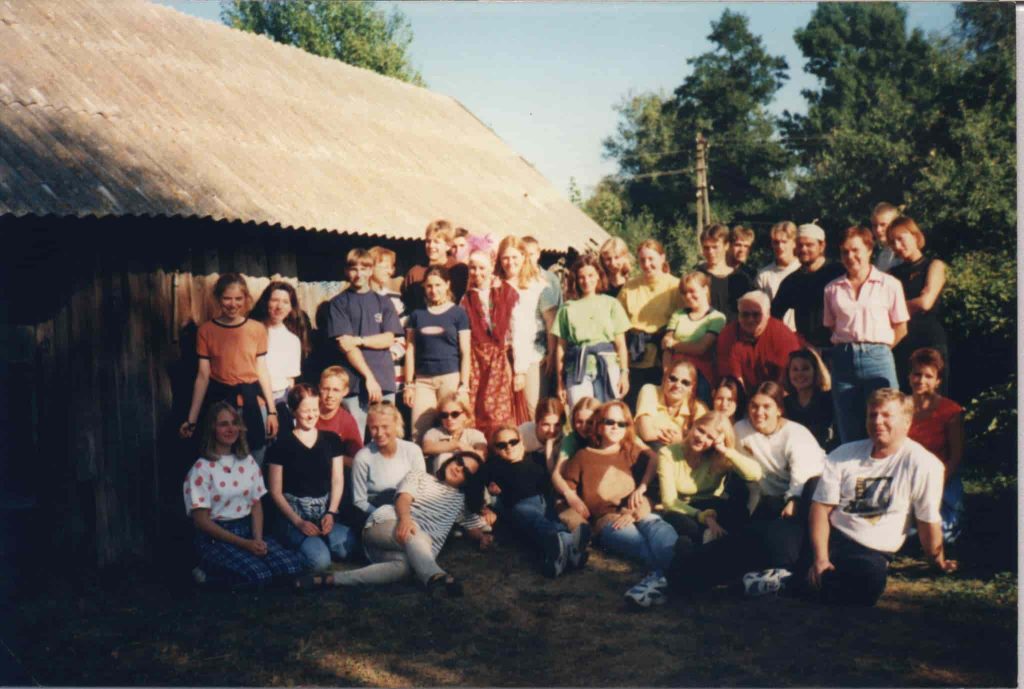
Initially he considered going to the US or UK, but when the opportunity arose to go to Estonia, he took it. As a highschooler in 1997 and again in 1999, he spent several weeks at Sütevaka Gymnasium in Pärnu, Estonia's fourth largest city known for its architecture and beachfront promenade. Sütevaka is also a renowned, arts-oriented high school. Yves made an interesting group of friends there, some of whom have since become filmmakers, artists, and writers.

"Many of the people I met then are still my friends today," says Yves. He also felt a kinship to Estonians, since he had grown up in eastern Germany in the 1980s. And he was particularly impressed by the technological changes taking place in the country which, unlike East Germany, did not have a western half to lean on. "They had to create everything from scratch," he recalls.
When Yves first spent time in Estonia, Tiger Leap, a program to make computers and the internet available in all state schools, was well underway, and there was a sense that digitalization was a component of Estonia's future. It left an impression on him and inspired him.
Years of fieldwork
Estonia became the focus of Yves' academic career and he connected his bachelor's and master's theses, as well as his PhD to Estonian topics. His field of study has been political science, with an emphasis on minority rights and societal divisions. His 2013 PhD for example examined whether Estonia's social divisions were national or socio-economic in nature.
"The conclusion was that the divide is primarily socio-economic, not ethnic, though it is closely connected to decisions made in the 1990s, especially regarding citizenship," Yves comments.
As part of his studies, he spent even more time in Estonia, including a six-month-long period in 2007, when he was present for the rioting that surrounded the removal of a Soviet war monument and the ensuing cyberattacks. "It was an intense and fascinating time to be there," recalls Yves. "It became very clear how narratives, media pressure, and external influence, especially from Russia, could escalate tensions," he says. "It was also one of the first examples of modern hybrid warfare, including cyberattacks and information campaigns."
He said that the overall outcome of those events was positive, as people began to talk openly about issues that had been avoided for years. But when the global financial crisis hit, the discussions faded from public attention."For me, this period reinforced how important it is to understand societal divides, not only socially, but also in terms of security," Yves remarks.
A most unique e-resident
While Yves' main role at the University of St. Gallen is administrative, he also is a lecturer, teaching courses on the history of the Baltic States, nationalism, and Eastern Europe. He also gives public lectures on these topics. Many of his students have almost no prior knowledge of the region, but later have decided to travel north to Estonia to see it for themselves. "They tell me they understood what they were seeing because of what we discussed in class," Yves says. "That kind of feedback is the best reward."
When Estonia rolled out e-Residency, Yves decided that this was something he had to try. He applied for and received e-Residency during the COVID-19 pandemic in 2021, a time when most of the world had moved online to manage its affairs.
"Initially, my motivation wasn’t entrepreneurial," says Yves.
"I wanted to understand the system firsthand so I could teach it credibly to my students. I also wanted to experience how Estonia handles digital identity and data protection."
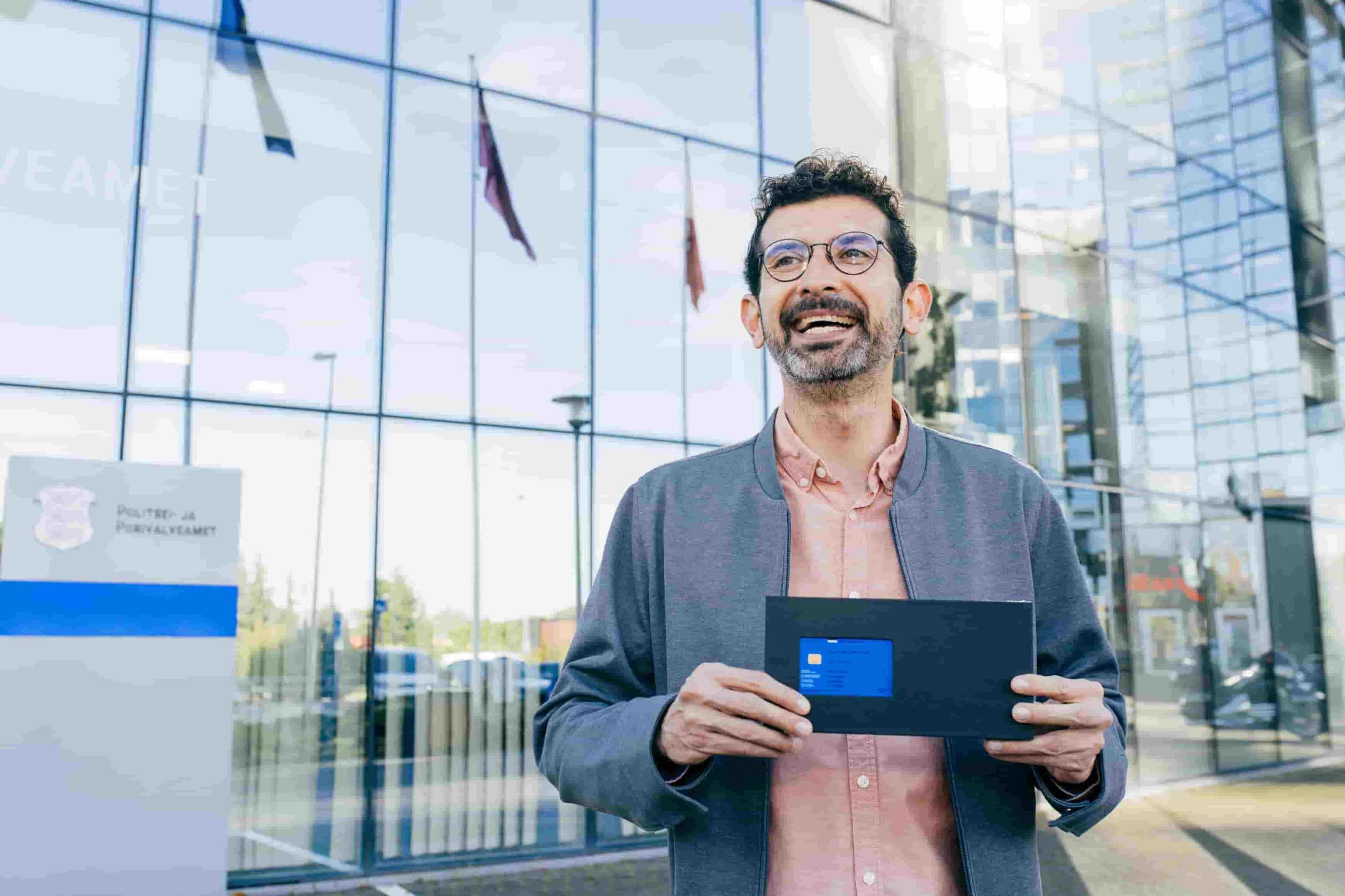
Yves has since used e-Residency in a variety of ways, such as to sign documents between the University of St. Gallen and an EU institution, or to terminate his garage rental contract in Switzerland. It was accepted in both instances. "It's legally recognized here because Estonia's system meets the highest EU standards," says Yves. "I use it regularly for Swiss contracts."
Yves has also joined the Estonian Defence League, or Kaitseliit, using his e-Residency card. While he is unable to take part in training activities from Switzerland, he serves in a supportive role. "Joining from abroad took some persistence, but eventually I was accepted;" says Yves. "Again, e-Residency made the administrative process much easier."
When he's in Estonia, he's used his e-Residency to acquire a long-term parking permit in Pärnu, where he loves to spend the summer with his wife and two children. "My wife is Tatar, and our children are what I jokingly call 'born Estonian fans,'" says Yves. "For them, holidays mean Estonia."

Small states
In his professional and personal lives, Yves continues to strive to bring more of Estonia to Switzerland and vice versa. He sees them as kindred small countries that could learn a lot from each other, and serves as the vice president of the Swiss-Baltic Committee, for example. He helps to organize Estonia-related events, such as the Nordic Chambers' Event this year at the University of St. Gallen, where he played a pivotal role. And he's a sought after Baltic expert.
"I think Switzerland can learn a lot from Estonia, especially regarding digital governance, trust in the state, and data ownership," says Yves.
"At the same time, Estonia can learn from Switzerland’s long-term stability and high living standards," he adds. "Small states have a lot to learn from one another."
He also organizes trips to Estonia, which for Alpine people can seem somewhat exotic, for its flat, forested terrain. "In Switzerland, we're surrounded by mountains, which is wonderful, but sometimes you long for something completely different," he goes on. When he's there, if he's lucky, he takes in the Northern Lights in winter or the endlessly light White Nights in summer.
"Those long evenings, that light, it feels like it flows straight into you," he says. On such long, lingering evenings, he likes to stroll around his old haunts in Pärnu from his high school days.
"So much has changed but, for me, walking through Pärnu is very personal," he says. "I know the streets by heart from my youth and the wooden houses, the old trees, and the familiar paths are still there. It brings me right back to being 18 or 19 years old, walking those same streets late at night," says Yves. "That, too, is part of why Estonia continues to matter so much to me."
Apply for e-Residency
More from e-Residency
- Sign up for our newsletter
- Watch fresh video content - subscribe to our Youtube channel
- Meet our team and e-residents - register for our next Live Q&A