
survey: 69% of germans open to founding in another EU country
Bureaucracy is the biggest barrier to starting a business in Germany, and the majority of would-be founders call for fully digital processes
Bureaucratic hurdles are the biggest obstacle facing aspiring entrepreneurs in Germany on their path to self-employment – ranking even above financial risks. This is the finding of a current, representative study conducted by the polling institute Civey on behalf of e-Residency of Estonia. A total of 1,500 people in Germany who are concretely planning to start a business within the next two years, or are seriously considering doing so, were surveyed. The results paint a clear picture: the majority of respondents want digital, low-friction business registration processes and are willing to think beyond national borders to achieve this.
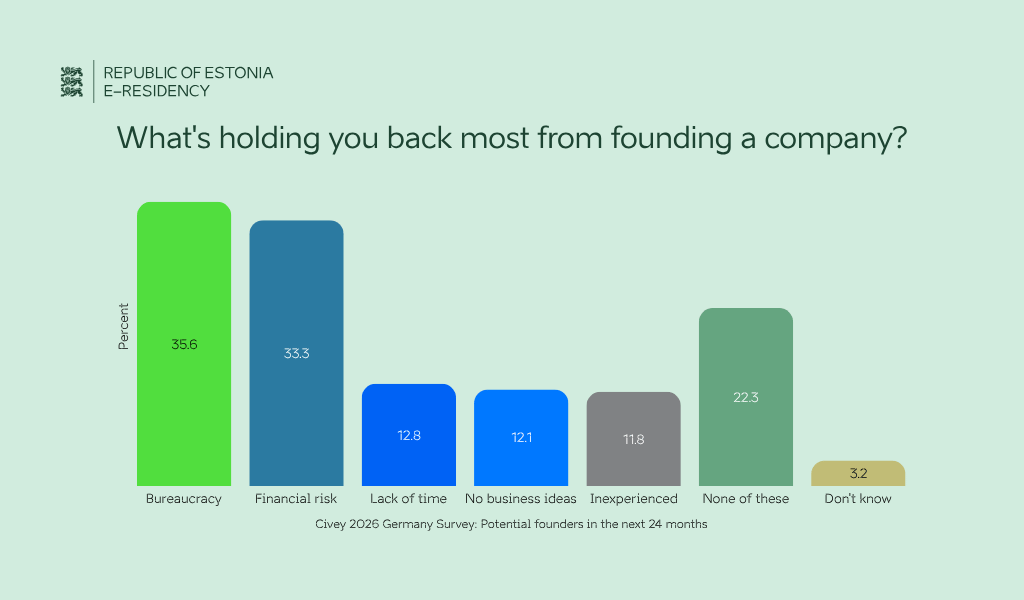
Bureaucracy overtakes financial risk as the biggest barrier to starting a business
When asked which aspects currently hold them back most from starting a company, 35.6% of respondents cited bureaucratic hurdles as the decisive factor – putting bureaucracy ahead of financial risk (33.3%). Additional barriers include lack of time due to personal commitments (12.8%), a missing business idea (12.1%), and lack of experience (11.8%). Around one in five (22.3%) currently see none of the listed barriers.
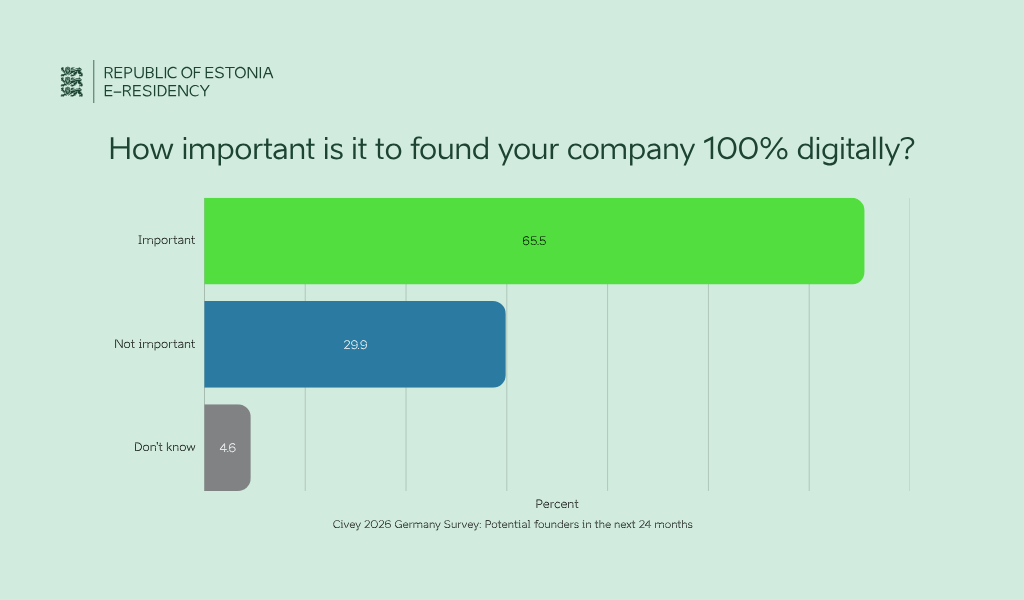
Two thirds want to found fully digitally
65.5% of respondents who are willing to start a business consider it important to be able to register a company entirely digitally and without in-person appointments at government offices. Only just under 30% rate this as less important or not important at all. The signal is clear: digital processes are perceived by a clear majority not as a "nice to have," but as a basic prerequisite of modern business conditions.
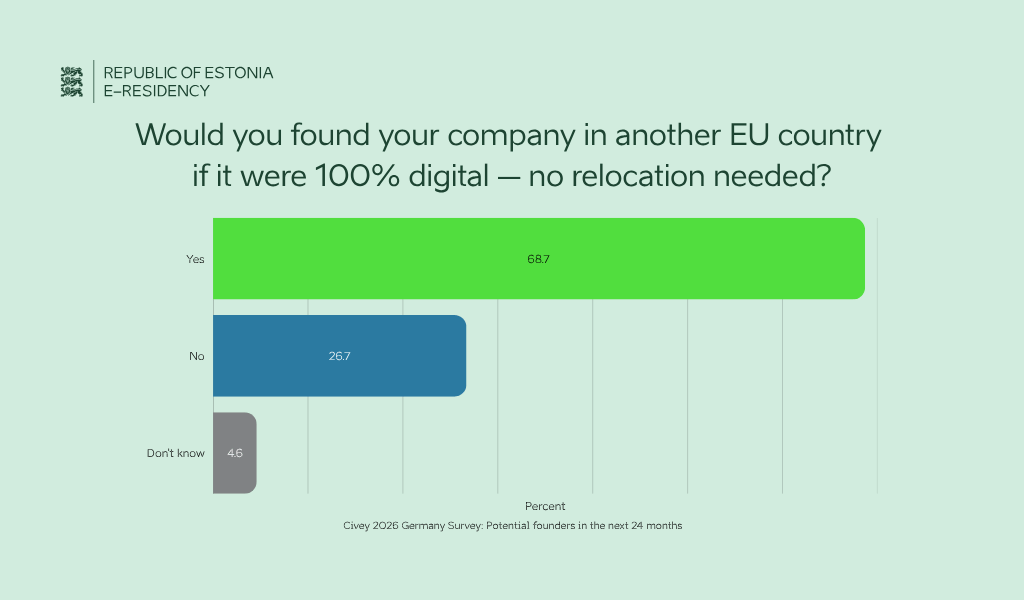
Nearly 70% open to founding in another EU country
Perhaps the most striking finding of the study: 68.7% of respondents can imagine founding their company in another European country – entirely digitally and without giving up their residence in Germany. Only 26.7% rule this out. This figure shows that for many prospective founders, the choice of location is increasingly viewed in functional terms: it is not national affiliation, but the quality of the framework conditions, that matters.
Findings in the context of the EU Inc. debate
The study results come at a time when an optional, EU-wide uniform company form is being intensively debated at the European level. On 18 March 2026, the European Commission presented its legislative proposal for the EU Inc. – a unified European legal form designed to enable fully digital company formation within 48 hours and to harmonize key rules for start-ups across Europe. The Civey data show that these reform approaches meet a real and measurable demand among aspiring entrepreneurs in Germany.
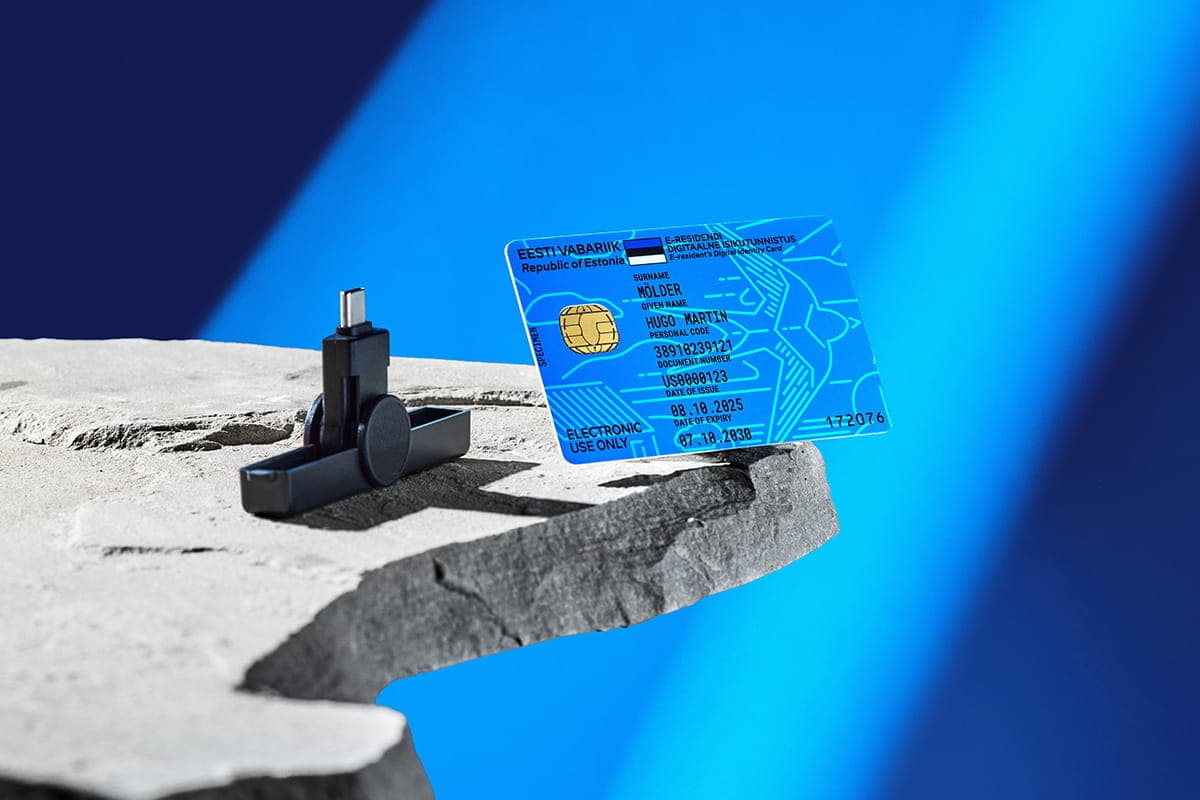
Estonia has already built a digital infrastructure since 2014 through e-Residency that operationally implements much of what EU Inc. sets as its goal: fully digital company formation, usable across borders, within a matter of hours. More than 41,000 companies have been founded this way by entrepreneurs from 185 countries.

"When more than two thirds of would-be founders in Germany are open to establishing their company in another EU country, it signals a fundamental shift: entrepreneurs no longer choose a business location out of habit, but are willing to seek out digitally advanced alternatives that work for them," says Mats Kuuskemaa, Country Director DACH at e-Residency.
"Estonia offers exactly that: fast, simple and fully digital company formation, a transparent regulatory environment, and a thriving startup ecosystem – all accessible remotely with e-Residency, without needing to even set foot in the country. Germany is our fastest-growing market, with applications going up by 49% in 2025 – showing that demand is there and continues to grow," he furthers.

"The cross-border company formation infrastructure that EU Inc. aims to create has been in large part functioning in Estonia for over a decade. Half of e-residents are from the European Union and already close to half of all Estonian startups have an e-resident on board. We welcome EU Inc. as a validation of the path Estonia pioneered, and as an opportunity to showcase the Estonian model as a working blueprint for making digital entrepreneurship the European standard," says Liina Vahtras, Managing Director of the e-Residency Programme.
About the study
The survey was conducted by the polling institute Civey on behalf of e-Residency of Estonia. A total of 1,500 people in Germany who plan to start a business within the next 24 months, or are seriously considering doing so, were surveyed. The survey period ran from 31 March to 17 April 2026. The statistical margin of error is approximately 5%. Multiple answers were permitted for the question on barriers to starting a business.
About e-Residency
Estonia's e-Residency programme was launched in late 2014 with the aim of giving foreign nationals secure access to Estonia's electronic government services, while simultaneously promoting cross-border entrepreneurship and generating additional revenue for the state budget. For founders, this means they can build and manage a company in Estonia remotely.
Since the programme launched in 2014, more than 140,000 people from 185 countries have received e-resident status and together founded approximately 41,000 companies. To date, more than 8,700 German e-residents have founded over 3,000 companies through e-Residency. Learn more about e-Residency in German.
More from e-Residency
- Sign up for our newsletter
- Watch fresh video content - subscribe to our Youtube channel
- Meet our team and e-residents - register for our next Live Q&A