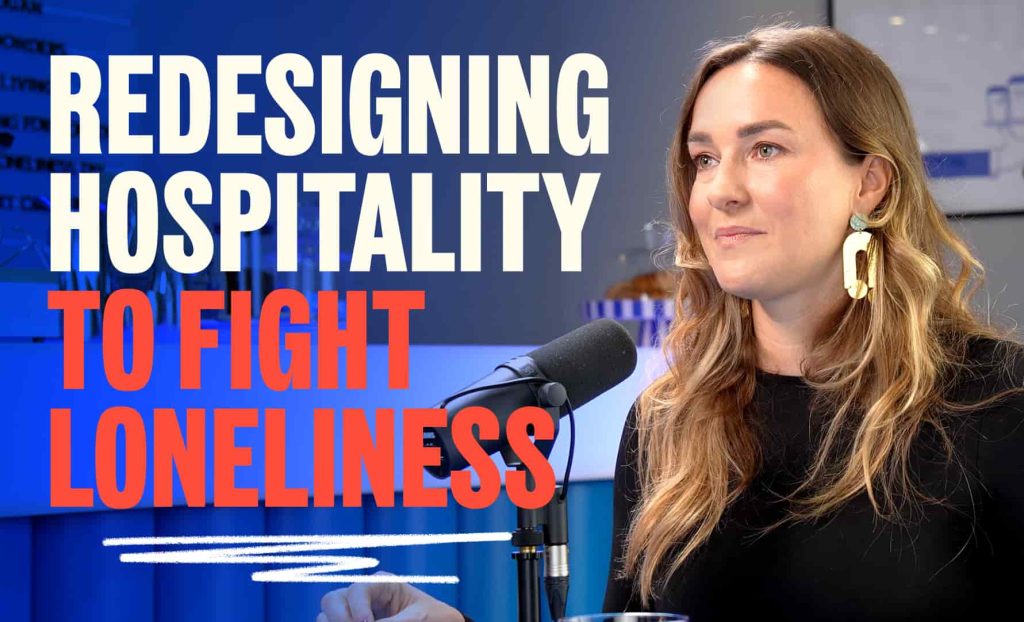
veerle donders on redesigning hospitality to fight loneliness
On the Winning Friends podcast, powered by e-Residency, Veerle Donders shows how hospitality brand Zoku fight loneliness in work travel with design and community

Loneliness isn’t something most companies put in their balance sheets. Yet it can quietly undermine global business: international assignments fail not only because of cost overruns or strategy mistakes, but because people find themselves isolated in unfamiliar cities. Studies suggest as many as one in six placements end prematurely, at huge personal and financial cost.
For Veerle Donders, Director of Concept & Brand at Zoku, this was more than a hospitality challenge – it was a business opportunity. What if a hotel could be redesigned from the ground up to fight loneliness? Not with perks or points, but with architecture, culture, and community.
The result was Zoku, founded in 2016 in Amsterdam and now also in Copenhagen, Vienna, and Paris. Called the “upside-down hotel,” it combines home, office, and social hub under one roof. And it offers a lesson every entrepreneur can learn: the problems people feel but don’t talk about often hide the biggest opportunities.
Most hotels optimise for efficiency: fast check-ins, clean rooms, loyalty tiers. Zoku asked a different question: what if the greatest cost wasn’t operational, but emotional?
“When people are sent abroad for work, the first two weeks feel like a holiday,” Veerle explains. “But then it kicks in – you don’t know anyone, you’re isolated, and that’s when loneliness strikes.”
For companies, that means failed assignments, poor productivity, and wasted investment. For individuals, it means burnout. For Zoku, it meant a clear market need.
Spotting hidden costs in your customer’s world – the pain points no one quantifies – can unlock entirely new avenues.
From a shower thought to seven prototypes
The spark came from co-founder Hans Meyer, who realised in the shower that business travel didn’t have to look the way it always had. But turning that idea into a business meant testing it relentlessly.
“Hans first decided to live as the target audience himself,” Veerle explains. “He called it Method Acting Plus. For six months he worked remotely from Washington, Bali, and Buenos Aires to experience first-hand the frustrations of being abroad as an entrepreneur.”
The team followed with 150 interviews, detailed experience maps, and even wooden mock-ups of rooms. They invited corporates over for pizza and beer sessions to gather feedback. After seven iterations, the first Zoku loft was born: a hybrid between apartment, office, and coworking hub.
The upside-down hotel
Products can be designed to shape behaviour and what makes Zoku distinctive isn’t just its concept, but its design. Unlike traditional hotels, the lobby isn’t tucked away. Instead, you walk straight into the top-floor living room – buzzing with a communal kitchen, coworking tables, and rooftop gardens. The private lofts sit below.
The design itself nudges people to connect. In the rooms, small choices matter: a four-person table encourages guests to invite others for dinner; a sliding staircase doubles as a place to sit and chat; compact kitchens invite guests to cook together.
“We deliberately design spaces that make it natural to bump into others, to share meals, to start conversations,” says Veerle.
Rituals and culture as the glue
If architecture sets the stage, culture makes it stick. At Zoku, rituals are the glue of community.
“Rituals are incredibly powerful,” Veerle says. “They give predictability and meaning. They’re what make people feel at home.”
Zoku has rituals for both staff and guests: Friday skål toasts, shared community dinners, local traditions like fika-style coffee breaks. Staff mark birthdays, celebrate wins, and formally welcome or farewell colleagues.
The rituals matter most when the two-week loneliness threshold hits. Instead of isolation, guests find ready-made entry points to connect.
Community as product
Zoku also recognised that community doesn’t happen by accident; it depends on the people who facilitate it. They hire and train for curiosity, not scripts.
Instead of receptionists, Zoku hires “sidekicks” – curious, empathetic hosts trained to ask better questions. “How was your flight?” doesn’t cut it. Instead: “Are you a foodie? Want tips for dinner? Do you like jazz clubs?”
These questions act as hooks that create conversations. Combined with community managers who orchestrate introductions and events, they make belonging the product itself. Regular beta sessions test new formats, ensuring the community is always evolving.
In the end, Zoku isn’t competing on room size or price. It’s competing on community. When customers feel part of something, loyalty follows naturally.
Beyond this episode: connection as strategy
Loneliness may not show up on spreadsheets, but it is one of the most expensive problems in global business. Veerle Donders shows that solving it takes more than perks. It requires design, rituals, curiosity, and culture.
Winning Friends is a podcast powered by Estonia’s e-Residency, hosted by Logan Merrick and Dylan Hey. Each episode explores how real relationships – with co-founders, communities, or even strangers in a hotel kitchen – shape the way we build.
Want to dig deeper into how global entrepreneurs are building borderless businesses? Don’t miss our article on Estonia’s e-Residency programme, a way for founders around the world to launch, run, and scale companies with European access, no matter where they live.
Watch the full episode of Winning Friends featuring Veerle Donders here.
Please to watch this video.
More from e-Residency
- Sign up for our newsletter
- Watch fresh video content - subscribe to our Youtube channel
- Meet our team and e-residents - register for our next Live Q&A