

women entrepreneurs who help other women succeed
Patricia Zeegers and Dr Eleftheria Egel founded EOS Academy to do what most entrepreneurship programmes do not: support women not just to start a business, but to build one that lasts. This is their story.
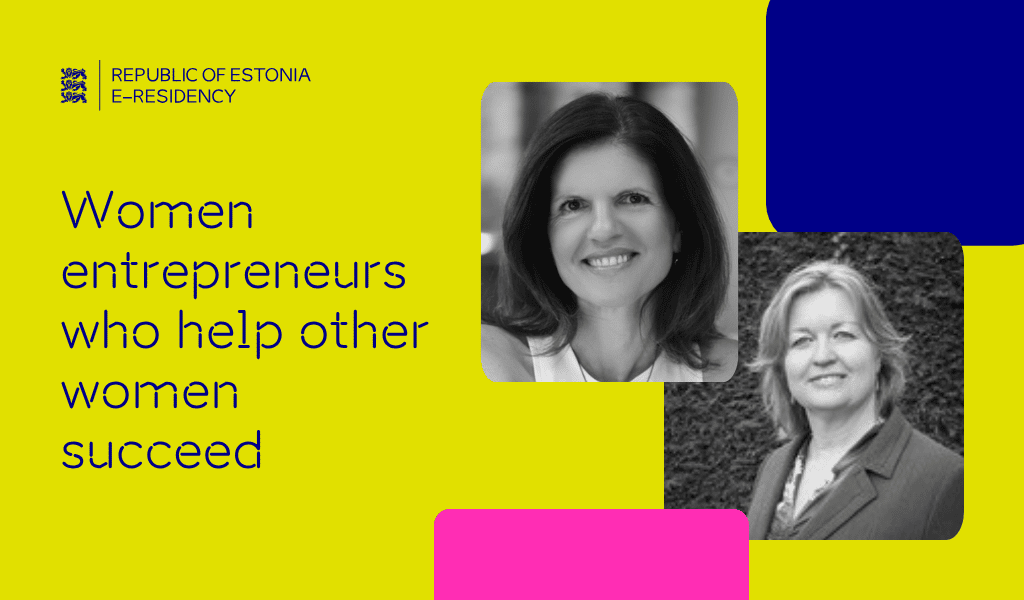
Most entrepreneurship programmes focus on one thing: helping women get started. Patricia Zeegers and Dr Eleftheria Egel believe this is only half the picture.
The two co-founders of EOS Academy have decades of experience in corporate environments, as well as in entrepreneurship. They have seen firsthand what holds women back, not just from starting businesses, but from building ones that are truly sustainable.
Their answer is EOS Academy: a company registered through e-Residency, Estonia's programme that allows entrepreneurs anywhere in the world to start and run an EU company entirely online. EOS Academy is dedicated to mid-career women in Europe who have been pushed out of corporate roles, or quietly sidelined within them, as well as those who simply sense it is time for work that is more aligned with who they are. We help them restart, reinvent, and build something of their own: a venture with purpose, and the chance to leave a legacy.
I spoke to Eleftheria and Patricia about their journeys, the barriers women face, and why the world needs more women entrepreneurs.
Two very different paths to entrepreneurship
Eleftheria: starting from purpose
Before entering the corporate world, Eleftheria started her professional life as an entrepreneur. In her hometown in Greece, she founded a foreign language school, which she ran for nine years.
“I started it because I was a teacher. It took me some time to understand that being a passionate teacher is not enough,” says Eleftheria. “To run a private school, you also need to be a businesswoman. What motivated me most was not just building the business itself, but the fact that I was creating something meaningful.”
The school had students aged four to 99, including children from remote villages who could not attend traditional classes. “We did not call it social entrepreneurship at the time. It was simply a need, and we responded to it.”
Patricia: starting from a drive to build
Patricia's background could not be more different. After an early career in the corporate sector, she spent more than a decade at Nike, where she established new departments across human resources for the EMEA region. Then she moved to Spain and took over a language academy with 40 teachers. The model was broken: teachers were travelling across the city at all hours, unable to go home, work full-time, or earn enough.
“I began bringing these companies online, which helped the teachers enormously and also helped the businesses. Once that was done and running well, I shifted again,” says Patricia.
She moved into consultancy, applying the same principle she always had: find where a system is broken, fix it, and move on.
“I thrive when I am building something new and making it as efficient and effective as possible. Once something is running smoothly, it does not need me anymore,” she says.
But it was a question from her father that set the deeper direction. “He pushed me to ask myself: you are building a brilliant career, but are you actually happy? What do you want? It was that question that made me want to go abroad and reinvent myself completely, on my own terms, from scratch.”
The gap EOS Academy was built to fill
Both founders repeatedly kept noticing the same pattern: a specific group of women in middle management, typically aged between 40 and 60, who had spent two or three decades in corporate environments and were now being pushed aside.
Women face multiple disadvantages in the workplace. These disadvantages increase with age, and the wider picture bears out the second half of the story: women remain significantly underrepresented in entrepreneurship.
“They did not have time to go to the pub after work and build the informal networks that tend to determine who gets promoted. They went home to take care of their children. They turned down the international assignments because they had families. And now, younger people are coming in. These women are now too expensive, and they find themselves slowly but politely moved aside,” says Eleftheria.
Building entrepreneurial mindset
These women often want to start their own businesses. But after decades working in large organisations, much of their entrepreneurial instinct has been trained out of them.
“Corporate environments do not reward independent initiative in the same way. You report. You comply. And so even if they had an entrepreneurial spirit at the start, it has been quietly suppressed,” Eleftheria says.
EOS Academy's answer is to give women a structured, safe environment to explore entrepreneurship before committing to it. They help participants build their entrepreneurial mindset, develop self-confidence, and test ideas without pressure.
“Risk and insecurity are the primary reasons women do not move forward. Fear of trying. Fear of failing. So we say: Come with us. We'll be right beside you, and you can test your idea in a safe space before committing to building the whole business,” Eleftheria explains.
“Startup accelerators are excellent, but they move fast and expect participants to arrive ready. We occupy an earlier, more sensitive space. We prepare women for that moment,” she adds.
Getting started is not enough
Patricia raises a concern that goes beyond mindset. Many programmes aimed at supporting women entrepreneurs focus solely on how to get them started, ignoring the structural reality of a woman's position within her family.
“How many women do we know who describe themselves as entrepreneurs but are working only during the hours their children are at school, fitting everything around the school run, the pick-ups, caring for elderly parents, managing the family's social calendar,” she asks. “All of that sits on top of the actual business work. And you cannot build a successful business on two or three hours a day. It is unsustainable.”
This is the gap EOS Academy is designed to close. Rather than leaving women to find focus on their own among everything else competing for their time, the programme provides a structured plan, expert coaching and peer support, and holds participants accountable. The aim is to provide not just encouragement, but also the kind of consistent structure that is difficult to maintain alone when time is limited and fragmented.
“If we are putting public money into these programmes, we should also be measuring how many of these businesses actually become successful,” she argues.
“That is exactly what I want EOS to stand for: not just getting women started, but supporting them all the way through to a point where the business actually supports them, rather than the other way around.”
Women and social entrepreneurship
A common element in everything that Eleftheria and Patricia describe is the connection between women and social entrepreneurship. Research shows that women are overrepresented in social enterprises compared to entrepreneurship in general, and both founders believe this is no coincidence. Eleftheria explores this further in her article on social entrepreneurship and why women excel at it.
“Women are genuinely well-equipped for social entrepreneurship, because we tend to have a more holistic view of impact. We have always had to manage the bigger picture, whether that is a team, an extended family, or a community. It is just what we do. That instinct, to think about how all the moving pieces connect, is exactly what good social enterprise requires," says Patricia.
But change cannot happen at just one level. It has to happen everywhere. And one of the most powerful levers is role models. "If we can create more visible role models in social entrepreneurship, and demonstrate that organisations can be financially stable while also being genuinely good, maybe that becomes a snowball," she says.
She ends with a thought on the journey itself:
"You cannot cross an ocean if you never leave sight of the shore. At some point you have to let go of certainty, step into the ambiguity, and keep moving forward even when you are not sure what you have left behind. You will get to the other side."
Why women are underrepresented as entrepreneurs
The reasons why fewer women become entrepreneurs are already well documented. Our new series Women in Entrepreneurship explores these in depth. Eleftheria and Patricia have lived and observed many of them directly.
For Eleftheria, one of the most powerful forces is self-limiting beliefs, which is often shaped by the environment in which women grow up. The data reflects this: only 52% of women believe they have the skills to start a business, compared to 63% of men. ‘I grew up with very few female role models in business, and for a long time I underestimated my own value," she says.
She also points to the cultural weight around money. "In Greek Orthodox tradition, and also in Catholicism, there is an ingrained sense that money is somehow dirty, that it does not represent your worth. For a long time, making money felt like a secondary concern for me. Almost a byproduct of doing meaningful work rather than something to pursue deliberately. The consequence of that was that I became overworked and underpaid, because I was focused entirely on quality and service and did not feel I could charge more."
Patricia was raised with a different message. Her father treated his two daughters no differently from anyone else and encouraged complete independence. "But when I hit the real world, it was not like that at all," she says. "At Nike, I did more work, took on more responsibility, and was paid less."
She is also clear on a myth she wants to challenge. "I do not think women are simply more risk-averse. I think they take more calculated risks. I see more women going in with a plan. When you look at long-term success rates, women entrepreneurs tend to outperform. Yet they still receive far less funding and far fewer opportunities. That makes no sense to me."
The barriers are real. But so is the evidence that when women do make the leap, they succeed. That is the story our new series is here to tell.
We asked "why are there fewer women entrepreneurs?" See what people had to say:
Please to watch this video.
Building a partnership across borders
Eleftheria and Patricia met through the Professional Women's Network (PWN), where Patricia was Global Vice President of Entrepreneurship and Eleftheria volunteered to help develop a programme. Once the programme had finished, the idea for EOS began to take shape.
Building the partnership has not been straightforward. Eleftheria lives in Germany, Patricia in Spain. They come from different backgrounds and have different approaches to problem-solving.
"Even a single word can mean something completely different to each of us. We start from different reference points, and finding the common ground has been one of the most interesting, and most demanding, parts of this journey," Eleftheria comments.
Patricia sees the difference as a strength. "Homogeneous teams have enormous blind spots. I have led enough teams to know that," she says. "When everyone thinks alike, you miss too much. What we need is a great deal of communication and the patience to understand where the other person is coming from before we move. I find it a fascinating ongoing journey."
They also took an unusual approach to launching. EOS Academy was incorporated in January 2026, but the two spent two years before that aligning their values, building a volunteer team, researching collaboration models and exploring how they wanted to work together.
"When we officially launched, we did not arrive at zero. We arrived carrying the lessons of those two years. Research shows that the human factor, leadership, trust, and alignment are among the common reasons startups fail. We took all of that seriously before we formalised anything. And we are in a much stronger, more confident position as a result," says Patricia.
How e-Residency fits the picture
The decision to register the EOS Academy through e-Residency was based on practicality. As Patricia and Eleftheria live in different countries, registering in either of their home countries was never a viable option due to cross-border bureaucracy.
"We looked at a range of options, and Estonia kept coming out on top. The digital infrastructure is second to none, which makes everything from administration to compliance genuinely straightforward," Patricia explains.
Looking at the broader e-Residency community, Eleftheria notes that the proportion of women founders remains low, a pattern consistent with entrepreneurship more widely. "That is not a surprise, but it does point to a gap," says Eleftheria.
Patricia explains that in her view, more support is needed for success:
"Estonia established e-Residency to attract talented people and growing businesses. But if people come in through the front door and leave through the back because they do not receive the support they need to actually build something sustainable, then the net result is simply churn. The intention is right. But the question is whether we can increase the proportion of those who succeed, and in our case, we specifically want to increase that for women. That has to be the goal."
Advice for women considering entrepreneurship
For women sitting on the edge of the decision, Eleftheria has a clear message: "Do not wait for a perfect tomorrow, because a perfect tomorrow does not exist."
"Start today with what you have. You have experience and you have knowledge, and both of those have value," she adds.
Dr Eleftheria Egel"One of the most common patterns we see in women is the belief that they are not yet ready, that they need to learn more, do more, prepare more before they can begin. That needs to stop. Take the first step today, and see what comes from it."
Patricia’s advice is about process: "Before you jump to solutions, understand the problem deeply. Look at it from every angle. Most of the time, when people move too fast to innovation, they have not fully thought through what they are solving for, and they end up with the wrong answer."
If you are ready to take the next step, our guide to the skills that matter most as an entrepreneur on the e-Residency blog is a good place to start.
Get involved
You can find out more about EOS Academy at eosacademy.global. There are two ways to get involved: Try their first course, Social Entrepreneurship Essentials, while it's still taking shape — your reactions will help shape what it becomes.
And join the WhatsApp group to walk this alongside other women in the same chapter.
If you are considering starting your own business and want the freedom to work from anywhere, e-Residency offers a low-cost, low-risk way to establish a trusted EU company entirely online. Learn more about how e-Residency can empower women entrepreneurs and see whether it could be the right tool for you.
Follow our Women in Entrepreneurship series, a dedicated collection of articles, interviews and resources on the e-Residency blog that focuses entirely on women in entrepreneurship. In this series, we explore the barriers women face, share stories of women e-resident entrepreneurs who have built businesses across borders, and offer practical guidance for women who want to explore entrepreneurship on their own terms.
More from e-Residency
- Sign up for our newsletter
- Watch fresh video content - subscribe to our Youtube channel
- Meet our team and e-residents - register for our next Live Q&A
Share this article:
Read next
From extreme sports pro to running mobile phone innovation in Estonia
How e-Residency helped Striga grow and get acquired
How to invest in startups: Lessons from two business angels
Swiss researcher discovers creative use cases for e-Residency