
social entrepreneurship – and why women excel at it
Social entrepreneurship attempts to solve society's challenges through business, but it may also offer a path for more women to become entrepreneurs.
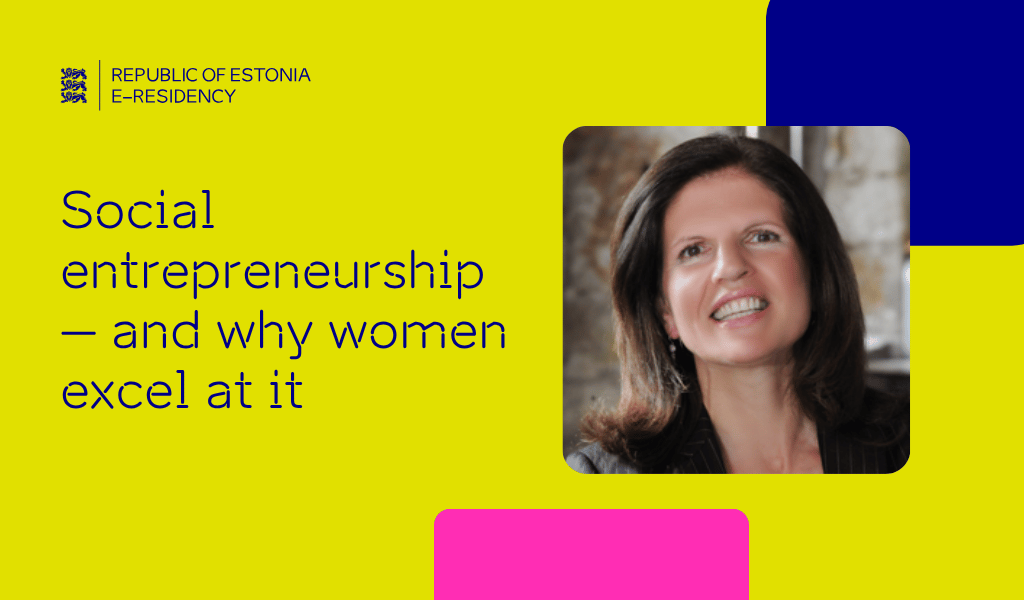
Dr Eleftheria Egel
Eleftheria Egel is an e-resident, the cofounder of EOS Academy, a social edtech startup based in Estonia, and the author of "What Hinders Me from Moving Ahead?" published in Exploring Gender at Work (Springer, 2021). EOS Academy is on a mission to enable mid-career women in the EU to build social enterprises from lived experience, through tailored learning, mentorship and community support.
Everyone has a theory about why fewer women start businesses. Funding is harder to access. Bias is real. Structural barriers persist. These things are true. But they describe the environment. They don't explain what happens inside a woman standing at the threshold of an entrepreneurial decision and hesitating.
That is what my research set out to find. Published as "What Hinders Me from Moving Ahead?", it pointed to something more fundamental than access or bias. It pointed to identity.
The real barrier: not skills, but belief
The Global Entrepreneurship Monitor (GEM) 2024/2025 Women's Entrepreneurship Report is clear on the scale of the gap globally.
- One in ten women started a new business in 2024, compared to one in eight men.
- Only 52% of women believe they have the skills to start a business, compared to 63% of men.
- And women are almost 50% more likely than men to close a business for family or personal reasons.
This is not a skills gap. It is a belief gap. Researchers call it entrepreneurial self-efficacy – the belief in your own capacity to start and run a business. When it is low, people do not act. Not because they lack talent, but because they do not believe the path is for them.
In Europe, the gap is wider than anywhere else in the world. Despite strong institutional support, women in Europe report the lowest rates of opportunity recognition, startup skills, confidence and willingness to act despite fear of failure in any global region. The gap is not about resources. It is about belief.
And yet the same report finds that globally, women are 5% more likely than men to prioritise sustainability over economic goals and 2% more likely to cite making a difference as a primary motivation. European women are not less entrepreneurial. They are motivated differently. My research asked: what specifically holds that motivation back? The answer was identity.
See what people answered to the question "Why are there fewer women entrepreneurs?"
Please to watch this video.
What gets in the way
Identity is not one thing. It is a shifting mix of the roles we carry – mother, partner, professional, community member. These interact. Sometimes they collide.
For women considering entrepreneurship, a specific collision tends to happen. Our culture has long treated entrepreneurship as a masculine activity: aggressive, individualistic, risk-embracing. Women absorb this framework. They anticipate a mismatch between who they are and what an entrepreneur is supposed to be. When that mismatch is felt, self-belief drops.
But there is a subtler problem too. Becoming an entrepreneur means adding a new identity to the ones you already hold. If that identity feels incompatible with being a mother, a spouse, or the person your community recognises – the integration fails. The identities don't fit. And when they don't fit, women distance themselves from the idea, question their readiness, or quietly let it go.
This is not a character flaw. It is a predictable response to a model of entrepreneurship that was never built for them.
Moving through it requires something researchers call identity undoing – letting go of fixed assumptions about who we are. About the roles we must play, the limits we have internalised. And, as part of that, questioning what entrepreneurship is and whether it can look different from the image we have been given. When those assumptions loosen, a new entrepreneurial identity can emerge. One that actually fits. That process does not happen alone. It needs support, community, and room to explore.
To understand why the entrepreneurial identity conflict is so persistent, we need to look at where it actually comes from.
But first, what is social entrepreneurship?
A social enterprise (SE) is a broad, overarching term for any nonprofit venture or revenue-generating activity founded to create positive social impact while operating with reference to a financial bottom line – what Emerson (2003) calls "blended value."
Across definitions, two elements are consistently present: a clear social mission and an inherent trade-off between value capture (financial impact) and value creation (social impact). This trade-off will largely define their business model.
Here are some useful, alternative definitions that help clarify the nature of a SE:
- In The Meaning of “Social Entrepreneurship”, J. Gregory Dees defines them as hybrid organisations pursuing a social mission while relying on a commercial business model
- The EU defines them as spearhead initiatives aiming to make a large, positive, societal impact while simultaneously being economically viable and sustainable
- The Ashoka NGO describes them as organisations striving to solve social problems at a systemic level using innovative, sustainable, scalable and measurable approaches
- Defined social entrepreneurial activity as any kind of activity, organisation or initiative that has a particularly social, environmental or community objective.
As you will realise, all definitions agree that two aspects need to be present for a business to be a social enterprise: that of “social mission” and “trade-off between profitability and social impact”.
Why social entrepreneurship changes things
In our case, the entrepreneurial identity conflict women experience has three interlocking sources. First, entrepreneurship has been culturally coded as masculine. Women anticipate a mismatch before they even begin. Second, the multiple roles women carry make integration harder. The entrepreneur identity competes with the mother, the spouse, the professional and the community member. Third, role models matter enormously for self-belief. In mainstream entrepreneurship, women simply do not see enough people who look like them succeeding.
Social entrepreneurship addresses all three at once. It redefines what an entrepreneur is. It draws on relational, systemic, community-oriented strengths that align with women's existing identities rather than competing with them. And it has a visible, growing community of women leading at every level.
When the form of entrepreneurship changes, the identity conflict changes with it.
The data on social entrepreneurship
The evidence is consistent. An OECD working paper found the gender gap in social entrepreneurship is significantly smaller than in mainstream commercial entrepreneurship. Social enterprises led by women and men are comparable in size, profitability and growth. Some 62% of women-led social ventures were the first to provide their kind of service in their region, compared to 54% of men-led ventures.
The European picture reinforces this. The OECD and European Commission's 2023 Missing Entrepreneurs report found women account for 73% of the EU's "missing" entrepreneurs – a potential 5.5 million additional businesses if the gap were closed. The European Social Enterprise Monitor surveyed 1,807 social enterprises across 30 European countries in 2023–2024 and found women in the majority at every organisational level, from workforce to board.
The woman who has spent years navigating complex organisations, holding multiple roles and managing competing demands has been building exactly the skills social entrepreneurship needs: systemic thinking, stakeholder sensitivity and collaborative leadership. These are not soft skills. In this field, they are core competencies.
Where the research meets the moment
One group sits at the intersection of everything this research describes: mid-career women managers who have been laid off.
Eurostat data shows women hold 60% of post-secondary qualifications in the EU but only 34.8% of management positions. When they are displaced, the consequences are severe. Research published in the Journal of the European Economic Association (2024) found women's earnings losses after a layoff are 35% higher than men's. The gap persists for five years. The wave of restructuring driven by AI and technological change has hit the sectors where these women work hardest. Another corporate role in a shrinking market is not always the answer – and many of these women know it.
What this group has is not a deficit. It is an unrealised asset. They have expertise. They understand problems from the inside. They have the capabilities. What they are missing is a structured, low-risk space to make the transition: tailored learning, expert coaching and peer support, with room to do the identity work without betting everything on it.
The barrier is not capability. It is belief. And belief can change – with the right support around it.
Learn more about how e-Residency can help women explore entrepreneurship in our blog article:
More from e-Residency
- Sign up for our newsletter
- Watch fresh video content - subscribe to our Youtube channel
- Meet our team and e-residents - register for our next Live Q&A