estonia uses ai in education to maintain a digital edge

Estonia’s edge in startups did not happen by accident. Learn how AI in education is the latest move in a decades-long strategy to build world-class tech talent.

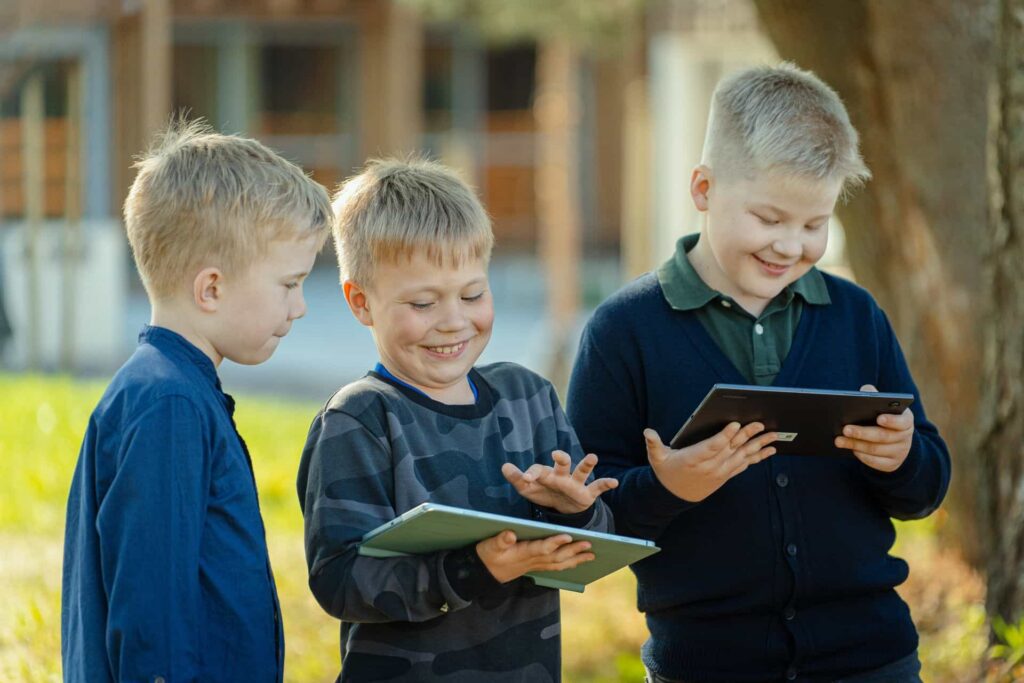
Estonian students using tablets and AI in education
Image: Ingel Martin

Sometimes it helps to take a step back to appreciate the whole picture. Estonia is a sparsely populated Northern European country of about 1.4 million people. More than half of its territory is covered in spruce, pine, and birch, and there were, at last count, about 2,317 islands. For a North American reference, think Maine or Nova Scotia. It's a country of hardy, self-reliant folk. 

In the 1930s, before it was taken over by the Soviet Union, Estonia's chief exports were agricultural products like butter, bacon, and timber. But Estonia isn't just exporting pigs anymore. 

The little country that could now specializes in unicorns.

Estonia has earned the reputation of being the Nordic Silicon Valley. It now boasts the most unicorns per capita in Europeand had the highest number of startups in Europe in 2022, according to that year's State of European Tech Report. Not real unicorns, mind you, just privately held startups valued at over $1 billion, including Veriff, ID.me, Zego, Pipedrive, Bolt, Wise, Playtech, and the granddaddy of them all, Skype, which Microsoft paid $8.5 billion to acquire in 2011.

And Estonia has been eager to share. In 2014, it introduced e-Residency, which allows anyone anywhere, after a thorough vetting, to become an "e-⁠resident" and run an Estonian (and thus European Union) company, as if they too were living in this land of forests, islands, and moose. 

To date, more than 133,000 people have become e-⁠residents and set up 38,900 companies.

The top of Europe

Evidence of Estonia's tech-savviness is not only found in its active startup sector. The government's services are entirely online, making it possible not only for entrepreneurs to easily manage their businesses, but also for average citizens to access public services. According to the Organisation for Economic Co-operation and Development (OECD), which Estonia joined in 2010, the country ranked sixth out of 33 participating member countries in the OECD Digital Government Index in 2023, increasing its position by 12 places from a previous ranking in 2019. 

Estonian students studying with tablets

The United Nations has similarly ranked Estonia at the top in e-governance, where the country, together with Denmark and Singapore, led its ranking of 193 member states in the 2024 UN e-Government Survey

The country's students have also shined in international rankings. The OECD's Programme for International Student Assessment (PISA) reported in its 2022 survey that Estonia's 15-year-olds were at the top of the world. Among European countries, Estonia tied Switzerland for first place in mathematics, was first place in science, and came in first place with Ireland in reading.

The legacy of Tiger Leap

There are various explanations for Estonia's digital dexterity. Some say that Estonia's experience during the Soviet period, which lasted from the end of World War II until it regained independence in August 1991, and particularly during the Era of Stagnation that started in the mid-1960s, forced Estonians to become handy and tech-savvy in all kinds of new ways.

Their innate resourcefulness, spurred on by chronic shortages under the Soviet system, made them a nation of "MacGuyvers," named for the popular 1980s television series about a national security agent who takes on complicated missions with his resourcefulness and knowledge. Indeed, the word macgyverlik, ("Like MacGyver") entered the Estonian language to describe that mindset.

But one real reason is a little less Hollywood. In the mid-1990s, looking for a way for Estonia to excel and build its economy after the Soviet collapse, a program was proposed by Toomas  Hendrik Ilves, then ambassador to the US and later the president of Estonia, along with Jaak Aaviksoo, who was at the time the country's minister of education. 

Please  to watch this video.

Together with President Lennart Meri, they unveiled Tiger Leap, which had at its aim making computers and internet access available to all schools in Estonia. All schools had both by the year 2001. Teachers were given basic ICT courses as well, and the long-term result has been not only that Estonia caught up with the West. In many ways, it has surpassed the capabilities of Western European countries. 

With Tiger Leap and ubiquitous internet access came the digital skills that have powered the successful adoption of e-governance, a generation of IT startup founders, and e-⁠Residency, too. 

Rebooting a Nation

"In my case, I can truly say that my success in the IT field is a direct result of Tiger Leap," says Riho Muttik, the cofounder and CEO of Parim, a provider of workforce management software. 

Muttik is from Elva, a town in South Estonia that is a long way from the real Silicon Valley. But thanks to Tiger Leap, Elva High School was at the end of the 1990s set up with a computer lab and computer classes, which sparked his interest. "That is where I first encountered web technologies and created my first websites," recalls Muttik. "The opportunities that came with Tiger Leap in schools definitely influenced my future study choices. It was only natural for me to start studying IT at the University of Tartu and then dive into the global IT business," he adds.

Joel Burke, former head of business development at e-Residency and the author of the book Rebooting a Nation: The Incredible Rise of Estonia, E-Government, and the Startup Revolution, has a similar take. 

"The program’s impact has been profound," Burke said in a recent article. "Today, it is difficult to find a founder of one of Estonia’s numerous tech companies who didn’t get at least some exposure to the web through the Tiger Leap program."

AI in education for a new generation

Siim Sikkut, cofounder of the e-⁠Residency program, was another Estonian pupil in the late 1990s impacted by Tiger Leap. He says that the program helped expose Estonian schoolkids to the internet and computing, teaching them to work with technology, rather than to fear it.

"This is how a tech-friendly digital society user base was born, and later we started feeling the impact in the wider economy," says Sikkut, who once served as the Estonian government's chief information officer and is now the managing partner of Digital Nation, which assists partners with Estonian IT expertise. 

"In every startup all the way to our unicorns and in every digital government outfit there are now ex-Tiger Leap kids at the helm, leading the uptake and creation of next solutions."

Siim Sikkut, cofounder of e-Residency

But now the Tiger Leap Generation, deep in its forties, wants to pass the proverbial torch to its own children by implementing AI in education. A year ago, the Estonian government unveiled its new endeavor, called AI Leap. The initiative, which was covered by The New York Times and The Guardian, commenced on September 1, 2025, with the goal of providing students and teachers with access to the best AI applications as well as giving them the skills necessary to use them effectively in learning.

"AI Leap was launched to do the same with AI technology, to expose the next generations to these tools, to have no fear, and for some to develop a deeper interest and start creating AI themselves," says Sikkut. "In that way, the next wave of the Estonian tech scene and digital governance will be AI-powered," he adds.

A phased introduction

The first phase of AI Leap has so far included 20,000 high school students in grades 10 and 11, as well as their 3,000 teachers. Future phases will expand its reach to vocational schools and incoming 10th-grade students later this year, which should add about 38,000 students and 2,000 teachers to the program.

An Estonian teacher teaches students outdoors with technology

There are different aspects to AI Leap as well. A program for teachers consists of training workshops and the establishment of school-based learning communities, the issuance of subject-specific teaching materials and tools, and ongoing collaboration with the Ministry of Education and Research to help manage changes in instruction. 

Students will also be encouraged to explore different use cases for AI tools via hackathons, co-creation sprints, debate tournaments, and creative workshops. And tech development and support is a third component, as new apps will be developed to serve the needs of students and teachers.

AI and teachers

Like its predecessor program, Tiger Leap, AI Leap is a public-private partnership. In February 2025, OpenAI, the San Francisco-based AI research organization, said it would provide Estonian students and teachers taking part in AI Leap with access to ChatGPT Edu, a version of ChatGPT customized for education systems. The partnership includes technical support and knowledge sharing for use cases that could range from feedback assistance and student support to study assistance and lesson planning.

According to Kaspar Korjus, former managing director of e-Residency and cofounder and CEO of Pactum AI, that focus on educating teachers as well as students is a key component of the new program. "Every student today is using AI anyway," says Korjus, who called the program a "big step forward" for the country.

"Teachers must know more about the capabilities of AI than their students, and what role it will start to play as their students join the workforce. They also need to know what the boundaries and threats of AI are." 

Kaspar Korjus, former managing director of e-Residency

As for naysayers, who see AI in education as a potential threat, Korjus says the opposite is true. "Forbidding the usage of AI is like forbidding students to use computers," he says. "And continuing with the same school programs is not reasonable either," says Korjus. "Teachers need to understand how to leverage AI in classes."

A land of unicorns?

And what will be the dividends? It will take time to see, but Korjus expects the innovation to continue. "I think that having a thorough grounding in AI will certainly lead to the creation of new unicorns," he says of the program's potential. 

When asked if AI Leap could deliver up another generation of Estonian tech entrepreneurs, Digital Nation's Sikkut responds simply, "It better." Altogether, he believes it should give Estonia another way to punch above its weight.

A young Estonian professional holding a laptop
Photo: Renee Altrov

AI Leap's ramifications could be felt across Estonian society and in every category, though, including among e-residents, who often opt to set up a business presence in Estonia to take advantage of its skilled workforce. As of November 2025, approximately 1,600 e-⁠resident companies employed around 5,700 people in Estonia, according to the Tax and Customs Board. In 2025, around 250 e-⁠resident companies hired employees in Estonia who hadn’t reported any the year before. 

"The intent behind the program is more pragmatic," says Sikkut. "It could spark the next wave of startups and unicorns at some point, but it really is aimed at making sure our workforce stays competitive and productive in any jobs and roles they do and in any sector," he says of AI Leap.

More from e-Residency