
faqs about estonia’s digital nomad visa
Have questions about Estonia’s Digital Nomad Visa? Read on for answers, including how it compares to e-Residency.
Estonia launched its long-awaited Digital Nomad Visa in 2020. At the time of its launch, former E-Residency Managing Director Ott Vatter said it was “great news for location-independent entrepreneurs around the world as it provides a legitimate way to live and work in Estonia for up to a year”.
This blog post contains detailed information in response to some frequently asked questions about the DNV to help you decide whether it’s for you.
1. What is the difference between e-Residency and the Digital Nomad Visa?
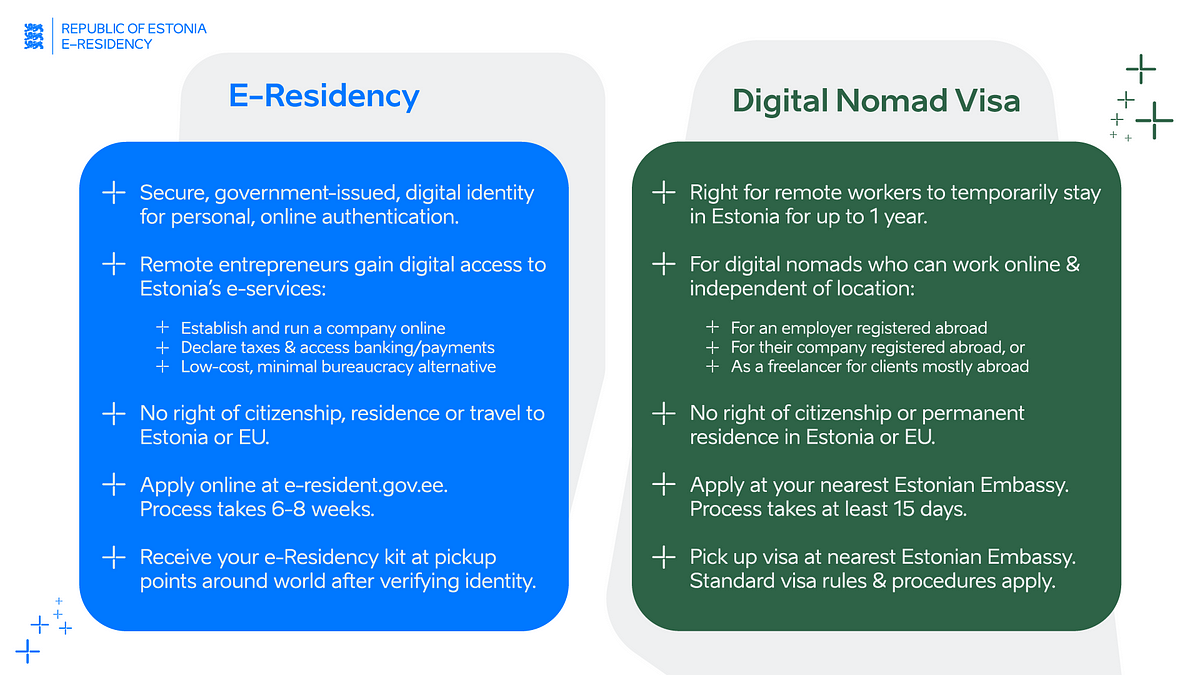
The key difference is that the Digital Nomad Visa (DNV) provides holders with the right to stay in Estonia temporarily, whereas e-Residency does not provide any travel rights.
E-Residency is a secure, government-issued, digital identity that provides access to Estonia’s trusted, transparent e-governance services and business environment. With their unique digital identity card, e-residents can securely authenticate themselves online, establish an Estonian company, digitally sign and encrypt documents and contracts in line with the highest EU standards, and access a broad range of e-services remotely.
E-Residency is therefore a great solution for digital nomads and other remote entrepreneurs who want to run a business without borders at low-cost and with minimal bureaucracy from wherever they are in the world. E-Residency provides no right of citizenship, residence or travel to Estonia or the EU.
The DNV provides eligible digital nomads with a temporary basis to live and work remotely in Estonia for up to a year. It is meant for people who can perform their work location-independently using telecommunications technologies and who work either: for an employer registered abroad, for their company registered abroad, or as a freelancer for clients mostly abroad.
Staying in Estonia on the DNV does not give the right to obtain Estonian citizenship or permanent residency. The DNV is not a residence permit but a temporary stay. Standard Estonian Government visa rules and procedures apply in addition to proof of digital nomad eligibility.
The DNV is not connected to e-Residency and being an e-resident is not a prerequisite to applying for the DNV and does not simplify the application process. It is possible that this could change in future as solutions are developed to enable integration of Estonian e-governance solutions like e-Residency with the DNV. Many e-residents will be eligible to apply, but will be subject to the same application rules and procedures as non e-residents.
We do envision, however, that having an e-Residency digital identity card could be helpful for holders of a DNV when they are staying in Estonia as it will enable them to take advantage of some of the country’s e-services while they are here.
2. When did applications open?
Applications for the DNV opened on 1 August 2020, when the implementing legislation became effective.
You can pre-fill the application form online here, then print and sign it, and gather all of your other supporting documents to take to your nearest Estonian Representation that handles visa applications or a Police and Border Guard office in Estonia. See FAQ 7 below for detailed information.
3. Who is eligible to apply?
To be eligible, you must prove that you can work location-independently using telecommunications technologies, essentially that you’re a ‘digital nomad’.
In addition, you will need to prove that you fit under any one of the three following categories:
- You work for an employer that is registered in a foreign country and you have a contract of work with that employer;
- You conduct business activity for a company that is registered in a foreign country and of which you are a partner/shareholder; or
- You offer freelance or consulting services mostly to clients, whose permanent establishments are in a foreign country, and with whom you have contracts.
For the first category, the legislation does not distinguish between public or private sector employers. So you will be eligible whether your employer is a private company, a public sector agency (e.g. government or regulatory body), or a not-for-profit entity. What is important is that you have a contract of employment with the employer and you are able to work remotely using telecommunications technologies.
The other important eligibility requirement to be aware of is the income threshold, which is meant to prove how you will support yourself during your time in Estonia. An applicant must provide evidence of their income during the six months preceding the application. Currently, the monthly income threshold is €4,500 (gross of tax). See more in question 19 below.
4. Are there any eligibility restrictions?
There are currently restrictions on visa applications for Russian and Belarusian citizens.
5. Is there a limit to how many visas will be issued?
There is no limit for the number of applications or visas issued.
6. How can I apply?
Applications opened on 1 August 2020 at Estonian Representations that handle visa applications (or if you are already legally in Estonia, you can apply at a Police and Border Guard office).
NB: The only official ways to apply for a DNV are: (1) directly through an Estonian Representation that handles visa applications, (2) directly at a Police and Border Guard office 3) at a VFS office, which has been delegated the right to handle DNV applications on behalf of the Estonian Government.
The first step is to carefully read the eligibility requirements set out in question 2 above.
If you meet the eligibility requirements, complete the visa application form (which you can pre-fill online).
The DNV is subject to standard rules and procedures for issuing visas to stay in Estonia, including those that relate to making the relevant visa application, having a valid travel document, paying the state fee for a visa application, having adequate health insurance and financial resources, and passing a background check. Links to more information on these standard rules and procedures are provided in question 11 below.
The main difference for the DNV in contrast to other visas to Estonia is that, in addition to the standard visa application procedures, you will need to provide information and documents proving your eligibility as a digital nomad (see question 8 below).
When applying for a DNV, you can apply for either an Estonian long-stay visa (D-visa) or a short-stay visa (C-visa), depending on your planned period of stay. The C-visa is for up to 90 days, and the D-visa is for up to 365 days. Applications can be made in English, Estonian, or Russian. The state fee for a D visa is €120 and for a C visa is €90.
Once you have completed the application form, print a copy and sign it and gather copies of all required supporting documents. Submit your application in-person at your nearest Estonian Embassy or Police and Border Guard office (check first whether you need to make an appointment) – and don’t forget your supporting documents!
7. There is no Estonian Embassy near me. How can I apply?
If there is no Estonian representation in your country, you must travel to the nearest Estonian Embassy that handles visa applications or an authorized VFS Global office in another country. VFS Global now facilitates Estonian visa applications in many regions worldwide, including the UK, India, and parts of Asia and Europe.
Alternatively, if you can enter Estonia visa-free or on a tourist visa, you may apply in person at a Police and Border Guard Board office once you arrive.
8. Which supporting documents help prove I'm a digital nomad?
In addition to the standard visa application procedures, you will need to provide information and documents proving your eligibility as a digital nomad. That is, you will need to provide:
- documents certifying that you can perform your work duties independent of location and that you use telecommunications technology in the performance of these duties;
- documents certifying that you continue to work either: for a foreign-registered employer, for a foreign-registered company in which you have a shareholding, or as a freelancer or consultant mainly providing services to clients with a foreign establishment according to a contractual relationship;
- documents certifying your income during the six months preceding the application and which indicate the required amount, regularity, and sources of the income; and
- a description of your study and professional life course.
Examples of documents proving the facts referred to the first two points above are:
- a written explanation of the applicant regarding the intention to use the visa for teleworking;
- a written confirmation from the employer that the applicant is able to perform work duties remotely;
- an employment contract or other contract showing your obligations to your employer or company;
- a certificate from the competent authority of the state of location of the applicant concerning the payment of mandatory state or local taxes or social security contributions in the state of location;
- a certificate from the competent authority of the state where the company is located, which shows the name, location, field of activity, your participation in the company and information concerning the legal representatives of the company; or
- any other documents which prove these facts.
Freelancers may not have written formal contracts every time they provide services for e.g. webinars, lectures and consultancies. Freelancers should note that where possible, you will need to provide written contracts, but e-mails and other documents can also be taken into account as a contract if you present them as such (as you can enter into a contract via an e-mail conversation). Essentially, show a form of written evidence proving you provide services as a freelancer and get paid accordingly.
9. How long does application processing take?
The relevant administrative authority with whom you make your application will review your application in full and conduct thorough background checks like they would for any visa application to Estonia. This process will take at least 15 days and on average around 30 days.
NO person is automatically eligible for a DNV and their application and background will be checked as carefully as for any other visa applicant.
10. Will I be notified if my application is successful?
Successful applicants will be notified when they need to visit an Estonian Embassy or Police and Border Guard office to verify their identity and pick up their DNV.

11. Where can I get more information and support about my application?
If you apply at an Estonian Embassy, please read the following information on the Ministry of Foreign Affairs website: for D visas and for C visas. For specific questions about your application, please contact your nearest Estonian Embassy for support.
If you apply at a Police and Border Guard Board office in Estonia, please read the information published on the PBGB website.
You can also reach out to PBGB migration advisers by phone: +372 612 3500 (Monday to Friday 9.00–15.00 Estonian time) or by email: migrationadvice@politsei.ee for specific questions regarding the DNV and your application.
12. Can a DNV-holder also work for an Estonian company/employer?
A foreigner staying in Estonia on a DNV can also work for an Estonian company / employer, but the main purpose of their trip must be the remote work specified in their application, i.e. that they can work independent of location with the help of telecommunications technologies and fit within one of the three eligibility categories set out above.
For example, an IT specialist who works for a foreign employer and stays in Estonia on a DNV may do additional work for an Estonian company as an IT specialist.
13. Do local companies that employ DNV-holders have registration obligations?
As this is additional employment, registration of short-term employment and payment of the average salary in Estonia is not required. However, the main purpose and activity of the stay in Estonia must continue to be related to teleworking for the benefit of a company, customers or employer abroad.
14. What are the tax obligations of a DNV-holder?
If a DNV-holder stays in Estonia for more than 183 days in a consecutive 12-month period, they will be considered an Estonian tax resident and should declare and pay taxes here. Read more about determining tax residency.
Otherwise, please direct your specific tax questions to the Estonian Tax and Customs Board by email to nonresident@emta.ee.
15. Can a DNV-holder stay in Estonia during the entire visa period?
Yes. A person staying in Estonia on the DNV may stay here for the entire validity period of the visa.
16. How long can a DNV-holder stay in other Schengen countries?
This depends on whether you have a short-stay or a long-stay visa.
For example, during the validity of an Estonian long-stay visa, the holder can stay in other countries in the Schengen area for 90 days within 180 consecutive days.
See the Ministry of Foreign Affairs website for more information.
17. Does a DNV-holder receive health insurance or pension in Estonia?
A DNV is a temporary basis for stay. A DNV-holder temporarily staying in Estonia must have a health insurance contract that guarantees the payment of medical expenses in case of illness or injury during their stay in Estonia.
The pension is collected by the digital nomad in the country where their social tax is paid, e.g. the country in which they are normally resident or employed.
18. Can DNV-holders bring family members?
If a person is issued with a DNV, that person’s spouse and minor child (and/or an adult child who is unable to cope independently due to a medical condition or disability) may apply for a visa under the same conditions as the DNV-holder. Decisions on spousal visas are made on a case-by-case basis. For example, if you apply for a long-stay D type DNV, your spouse and children should apply for visas too. If successful, they will be issued with a visa on the same conditions as your DNV.
Estonia recognises same-sex unions, so same-sex partners can apply for a visa to accompany their DNV-holding partner.
If a spouse is successful in being granted a visa to accompany a DNV-holder, whether they can work will depend on the conditions of their visa.

19. How is the income requirement determined?
The amount of sufficient funds for applying for a digital nomad visa is €150 per day. As the DNV can be issued for a period of up to twelve months, digital nomads are not expected to have €54,750 (i.e. €150 x 365 days) when submitting their application. It is expected that a person should have financial means for at least the first month of €4,500 euros (i.e. €150 x 30 days).
Decisions as to what constitutes sufficient legal income will be made on a case-by-case basis based on the proof of income you submit. A person applying for a digital nomad visa has to provide evidence of sufficient legal income within the past six months. The amount of the previous income that is sufficient is based on the €150 per day / €4,500 per month benchmark. Using this, it can be estimated whether you are able to fulfil the requirement of sufficient financial means in the coming months.
The authority reviewing your application will look at all of the evidence you provide, including your bank balance and income in the past six months from all sources. This could include your salary, dividends, director fees, rental income, interest from investments, shares, assets, etc.
20. Can I renew or extend my visa? For how long, and how many times?
Renewal or extension of a DNV is not possible, but you could apply again for a second DNV. However, in Estonia (and the EU), the maximum period of stay of a foreigner on long-stay visas shall not be longer than 548 days within 730 consecutive days.
Therefore, if you apply for a DNV for the maximum period of one year. After that, you can apply for a second DNV for a maximum period of six months. These would be two separate applications and decisions, and if you are successful in both, two separate stay visas. After staying in Estonia for 1.5 years you will be required to leave Estonia.
Please note that staying in Estonia on a DNV has no advantage with regard to gaining any form of residence permit in Estonia.
21. Where can I find out more information?
We encourage you to join our great community of 130,000+ e-residents from over 170 countries to follow the latest news about the DNV, e-Residency, and Estonia more broadly:
- Visit our Digital Nomad Visa webpage
More from e-Residency
- Sign up for our newsletter
- Watch fresh video content - subscribe to our Youtube channel
- Meet our team and e-residents - register for our next Live Q&A