

setting up a company in france vs estonia
Thinking of setting up a business in France? Compare costs, tax, and admin with Estonia to find the best option for your business.
Founders considering where to start a business in the EU will often have France near the top of their list. The country boasts three of the Financial Times’ top 10 Leading Start-up Hubs, with Station F claiming its place as the world’s biggest startup campus.
And there are undeniable advantages to using France as a business base, with its strong startup ecosystem, large domestic market, and its place at the heart of the EU’s single market. There are potential drawbacks however. Setting up a business in France means dealing with French bureaucracy, a process that can be slower and more complex than in other EU countries.
If you’re a foreigner considering where to get set up, Estonia is worth exploring as an alternative. Through its e-Residency programme, you can register and run an EU company entirely online, without setting foot in the country. The process is faster, the administration is simpler, and the tax system benefits founders who want to reinvest their profits in their growing business.
Let’s take a look at how to start a company in France, and how the pros and cons weigh up against Estonia.
How to start a business in France as a foreigner
France welcomes foreign entrepreneurs, and EU nationals can register a company on the same terms as French citizens. Non-EU nationals can also set up a company, but the requirements depend on whether you plan to operate from France or run the business remotely.
If you’re not planning to reside in France – which means spending more than 183 days per year there – then no visa or residence permit is required to register a company.
If you do want to live and work in France as a business owner, the process is more involved. Non-EU nationals must obtain either an "entrepreneur/profession libérale" residence permit, or a Passeport Talent permit under the "business founder" or "innovative project" category. To qualify, your business activity must be economically viable, be your principal activity, and correspond to your qualifications or professional experience. A standard salaried worker permit does not allow company creation or independent activity. Founders who hold one must switch status before they can legally operate a business, which creates a practical bottleneck for anyone looking to keep a job while getting started on their own business.
Choose your company structure
There is one important step of the process to consider before starting a business in France as a foreigner. France has a number of possible company structures, but the main options as a foreign founder are:
- SAS (Société par Actions Simplifiée): this is the most popular choice for startups and small businesses. It’s flexible, there’s no minimum share capital, and it’s straightforward to run.
- SARL (Société à Responsabilité Limitée): France's equivalent of a limited liability company. It’s more regulated than an SAS but still widely used.
- Entreprise Individuelle (EI): a sole trader regime with simplified accounting and tax. Revenue caps apply, so there’s a limit to how big this business can become, and you cannot separate personal and business liability.
How to register a company: France vs Estonia
The cost of registering a company in France is between €260 and €320, which includes the registry fee, a legal notice, and a beneficial owner filing. These are just the basic DIY costs however, and it is normal to factor in some level of legal and accounting support to help with the sometimes complex processes.
Registration is completed using the French government's centralised online portal, called Guichet Unique. The process takes typically around two to three weeks from start to finish, assuming your documentation is in order. Delays are common if foreign documents require certified translation or apostille. You need to have a French business bank account set up before this can be completed, although you can use a fintech bank such as Qonto or Shine.
To complete your registration in France, you’ll also need a business address in the country. You can pay for a domiciliation if you do not want to actually open an office in the country.
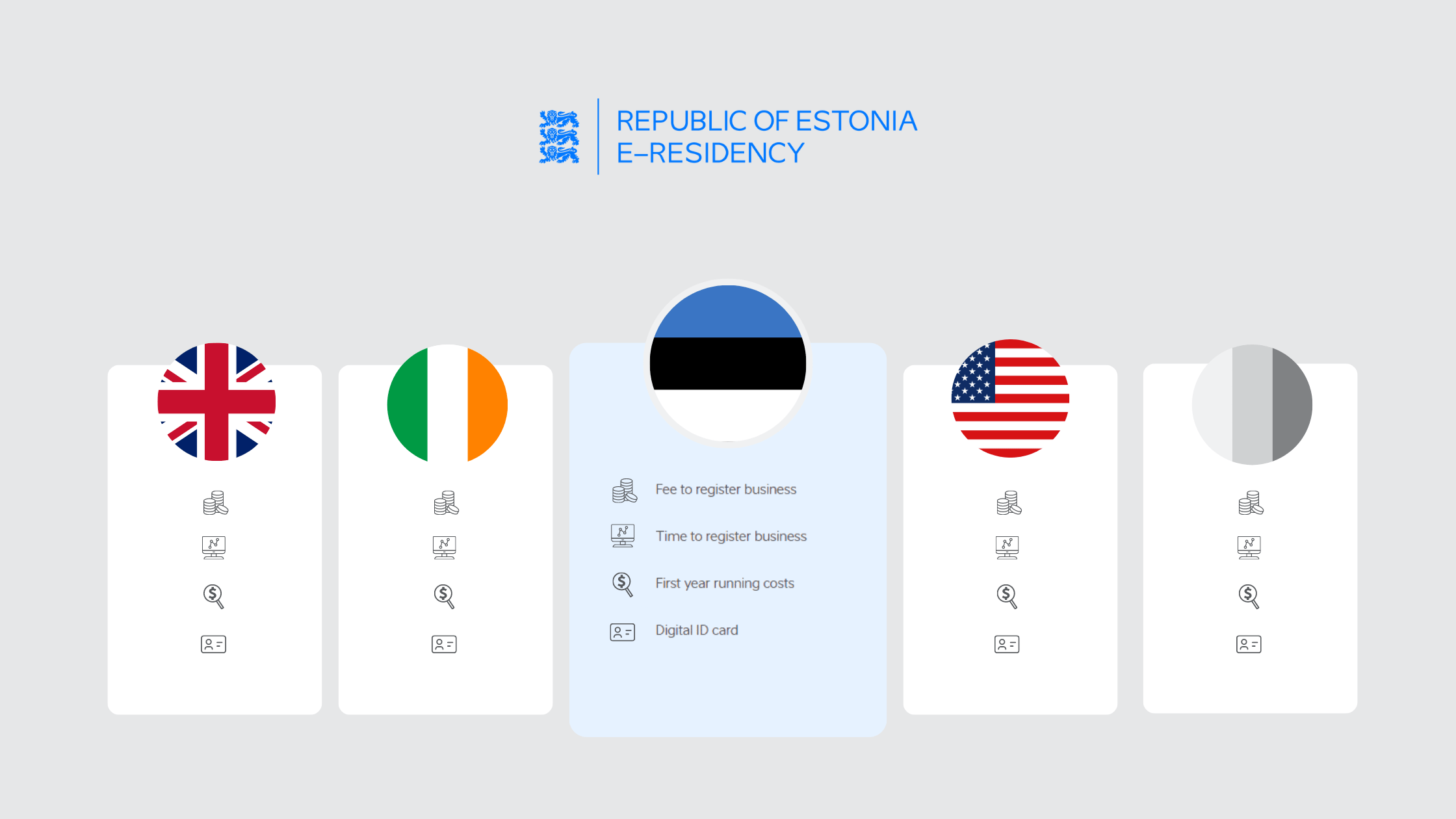
An advantage of registering a company in Estonia is that the process is more straightforward. It can all be done online, taking an average of just two hours to incorporate. The cost is also highly competitive, at around €600 for the first year. This covers the e-Residency application, the cost of registering the company, and hiring a contact person. You do not have to set foot in the country, and everything is managed digitally using your e-Residency digital ID.
Opening a business bank account: France vs Estonia
A French business bank account is required before you can complete company registration. You need it to deposit your share capital and obtain a certificate to proceed. Traditional French banks generally require in-person meetings, and documents not in French must be translated and apostilled. There are fintech options that could support remote onboarding for non-residents.
In Estonia, you can open a business account using an EU-licensed fintech such as Wise or Revolut, with no travel required. Traditional Estonian bank accounts are also available but typically require demonstrating a genuine connection to Estonia.
Company tax rates: France vs Estonia
Tax rates are one of the main considerations for any entrepreneur deciding where to start their business. Here are the rates in France and Estonia.
Corporate tax
The standard corporate income tax rate in France is 25%. However, SMEs with turnover of under €10 million and at least 75% of share capital held by individuals can benefit from a reduced rate of 15% on the first €42,500 of taxable profit. This tax is charged on all profits, whether you take them out of the business or not.
This is where Estonia comes into its own. The corporate tax rate is a flat 22%, but this only applies to distributed profits. Any profits that are reinvested back into the business are taxed at 0% – a significant advantage for founders who are focused on growth.
VAT
France's standard VAT rate is 20%, with reduced rates of 10% and 5.5% for certain goods and services. In Estonia, VAT registration is only required once revenue exceeds €40,000, and the standard rate is 24%. Estonia is part of the EU's One-Stop-Shop regime for simplified cross-border VAT reporting.
Dividends
In France, dividends are taxed at both company and shareholder level. The company first pays corporate income tax on its profits, then shareholders pay a further 30% flat tax (PFU, or ‘Prélèvement Forfaitaire Unique’) on any dividends they receive.
In Estonia, profits are untaxed until distributed, at which point the company pays corporate income tax calculated as 22/78 of the net payout to the shareholder (equivalent to 22% of gross profit). Shareholders may also owe personal income tax in their country of residence.
Corporate tax
Tax on undistributed profits
VAT rate
Dividends/distributions
Avg. time to file taxes annually
Time to register a business
Digital ID card
France
25% (15% on first €42,500 for qualifying SMEs)
Yes
20% (standard)
30% flat tax (PFU)
139 hours
4-8 days
No
Estonia
0% on reinvested profits; 22% on distributed profits
No
24% (standard)
22%
50 hours
2 hours
Yes
Corporate tax
France
25% (15% on first €42,500 for qualifying SMEs)
Estonia
0% on reinvested profits; 22% on distributed profits
Tax on undistributed profits
France
Yes
Estonia
No
VAT rate
France
20% (standard)
Estonia
24% (standard)
Dividends/distributions
France
30% flat tax (PFU)
Estonia
22%
Avg. time to file taxes annually
France
139 hours
Estonia
50 hours
Time to register a business
France
4-8 days
Estonia
2 hours
Digital ID card
France
No
Estonia
Yes
Which option is best for you? France vs Estonia
So between France and Estonia, you have two solid options for setting up a business. Let's go over the advantages of each one last time.
Why set up a business in France?
- Large domestic market with direct access to EU customers and partners
- World-renowned startup ecosystem
- A reduced corporate tax rate of 15% on the first €42,500 of profit for qualifying small businesses
- Likely the best choice if your business is primarily France-facing and you plan to be based there
Why set up a business in Estonia?
- Streamlined online management with incorporation taking an average of just two hours
- 0% tax on all reinvested profits, only triggering 22% tax upon distribution
- Seamless access to the European Union market and digital services
- Low setup costs with no travel required to open fintech bank accounts
Ready to become an e-resident?
More from e-Residency
- Sign up for our newsletter
- Watch fresh video content - subscribe to our Youtube channel
- Meet our team and e-residents - register for our next Live Q&A