



setting up a company in dubai vs estonia
Setting up a company in Dubai is becoming a popular option for entrepreneurs. Here’s how it compares with setting up in Estonia.
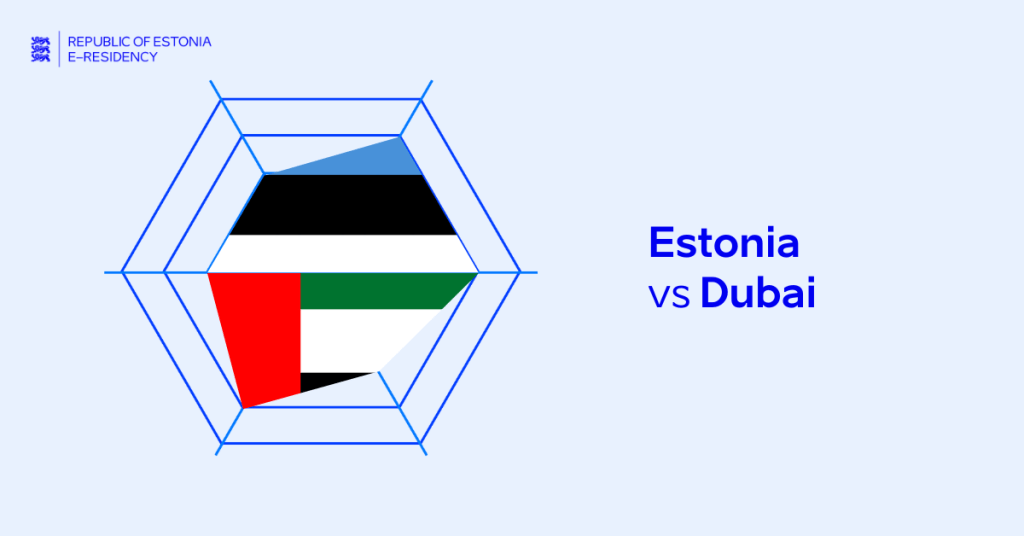
When entrepreneurs look for a base to set up their business, more and more are turning to Dubai these days. The largest city in the UAE has built itself a reputation as a business-friendly hub, where low tax and attractive residency and visa options create a favourable environment for entrepreneurs to thrive.
There are, however, a number of factors to consider. When you're choosing where to get set up, you'll be thinking about company registration, tax, getting a bank account, and much more.
Dubai isn't the only option worth exploring. Estonia has a compelling offer too, with its e-Residency programme allowing you to manage your company from anywhere. It also has the advantage of being a less complex process. In this article, we’ll break down the pros and cons of starting a business in Dubai or Estonia, giving you a clear idea of the best options for your needs.
Setting up a business in Dubai
Dubai is regarded as a top destination for entrepreneurs for a reason. The UAE-based TASC Corporate Services ranked it as the world’s most attractive destination for entrepreneurs in a 2025 analysis, citing unique advantages such as:
- 0% income tax
- Quick processing in just 10 days
- Golden visas
- International recognition as a global hub
In that analysis Estonia was just below Dubai in third place, with its access to the EU market, cutting-edge digital ID and e-services, and its “unmatched affordability”.
Here is how to start a business in Dubai. The process involves several stages and can be complex compared to more streamlined alternatives.
Choose your business activity
Start by choosing your business activity. With thousands of business activities to choose from, entrepreneurs of all stripes can consider Dubai as their location.
Decide on the structure
You have the choice of a number of different business structures:
- Free zone: These specialise in specific industry sectors, allow full foreign ownership, and often come with 0% tax incentive
- Dubai mainland: These companies can operate inside and outside of the UAE, and will usually be subject to 9% corporate tax on income above AED 375,000 (~€87,150 or £76,000)
Request initial approval
For this you’ll request approval from the appropriate government department. They will ask for a number of documents including things like:
- A copy of your passport or ID
- A copy of your residence permit or visa
- The company's articles of association
- A feasibility study of the project
This stage costs AED 120 (~€27 or £24).
Register your company’s trade name
Choose your company’s name, making sure it’s reflective of your business activities and doesn’t infringe on the names of established international or UAE-based organisations. This stage costs AED 620 (~€143 or £126).
Request a trade licence and open a bank account
There are differing costs for getting a trade licence depending on the specific licence you need. Finally, you’ll need to open a Dubai business bank account and register for applicable taxes.
Now let’s dig into the details of the pros and cons of setting up a company in Dubai and Estonia.
Company registration in Dubai vs Estonia
One clear advantage to setting up a company in Estonia over Dubai is how streamlined and simple the process is. To get set up in Estonia, you don’t need an agent or local director. You don’t even need to step foot in the country. Instead, you can do it all online. It takes an average of just two hours to incorporate a business in Estonia. It’s also remarkably inexpensive, with a rough cost of around €600 for the first year.
As we’ve outlined above, the process in Dubai can be a little more complex, although setting up a company on the mainland or in a free zone is streamlined and efficient. While the most popular route for expats is to set up in a free zone, each has its own particular requirements. These will include:
- Getting your business licence
- Obtaining a visa package
- Confirming business activities
- Paying for an office solution
- Completing all documentation
The rough cost of company registration in Dubai in the first year can be between AED 10,000-50,000 (~€2,316-€11,580 or £2,037-£10,185).
Company tax in Dubai vs Estonia
Comparing corporate tax
One of the main draws of setting up a company in Dubai is the tax advantages. Generally speaking, there is an extremely competitive corporate tax rate of 9% that applies to all taxable income exceeding AED 375,000 (~€87,150 or £76,000). Anything below this threshold has a 0% tax rate. This means small businesses – especially one-person freelance businesses – are well placed to enjoy low corporate tax rates.
If you meet strict qualifying criteria as a Qualifying Free Zone Person however, you can keep the 0% corporate tax rate. As there are a number of free zones to choose from, you must meet the requirements for the one you opt for – making Dubai business tax attractive but potentially complex.
In Estonia, there is a corporate tax rate of 22% – but it only applies on distributed profits. This means any profits that are reinvested back into the company are taxed at 0%. This makes it a great solution for new companies that are focused on growth.
VAT
Another Dubai business tax to consider is VAT. VAT is charged at 5% and applies when revenue exceeds AED 375,000 (~€87,150 or £76,000) – the same rate when corporate tax can kick in. There are some services – like certain financial ones – that are exempt from VAT.
In Estonia, you need to register for VAT if revenue exceeds €40,000, and in most cases the rate is 24%. Estonia is part of the EU's One-Stop-Shop and Import One-Stop-Shop regimes for simplified VAT reporting, making the process simple.
Income tax
There is, of course, Dubai’s famous 0% personal income tax, meaning any earnings from salaries or investments are free of tax. For this, you’d need to be a tax resident in Dubai.
Estonia's income tax rate, meanwhile, is a flat rate of 22%. Tax residents are taxed on their worldwide income, while non-residents are only taxed on their Estonia-sourced income – although they can apply for tax benefits or lower rates thanks to tax treaties.
Please to watch this video.
Business bank account in Dubai vs Estonia
Another area that can add complication to the process of setting up a business in Dubai is opening a bank account. To do so in Dubai requires physical presence in the country, and lots of documentation. Many banks also require a minimum starting balance, usually around AED 50,000 (~€11,616 or £10,142).
If you’re setting up a company through e-Residency in Estonia, on the other hand, you have the option of opening an Estonian bank account or using an EU-licensed fintech, such as Wise or Revolut. The fintechs don’t require travel to Estonia, and once approved, an account can be opened quickly with minimal fuss. Please note, though, that becoming an e-resident does not guarantee you an Estonian or EU bank account. Business bank accounts are granted in a separate process on a case-by-case basis by financial institutions.
Final comparison: Setting up a company in Dubai vs Estonia
So between Dubai and Estonia, you have two great options for setting up a business, depending on your needs and circumstances. Let’s go over the advantages of each one last time.
Why set up a business in Dubai?
- 0% personal income tax on salaries and investment returns for residents
- 0% corporate tax on profits below the AED 375,000 threshold
- Prestigious international standing as a global hub with attractive visa and residency options
- A physical headquarters ideal for those looking to relocate
Why set up a business in Estonia?
- Streamlined online management with incorporation taking an average of just two hours
- 0% tax on all reinvested profits, only triggering 22% tax upon distribution
- Seamless access to the European Union market and digital services
- Low setup costs with no travel required to open fintech bank accounts
Open an Estonian company online
More from e-Residency
- Sign up for our newsletter
- Watch fresh video content - subscribe to our Youtube channel
- Meet our team and e-residents - register for our next Live Q&A