

company registration in italy vs estonia
Thinking about company registration in Italy? Compare costs, tax, and admin with Estonia to find the best option for your business.
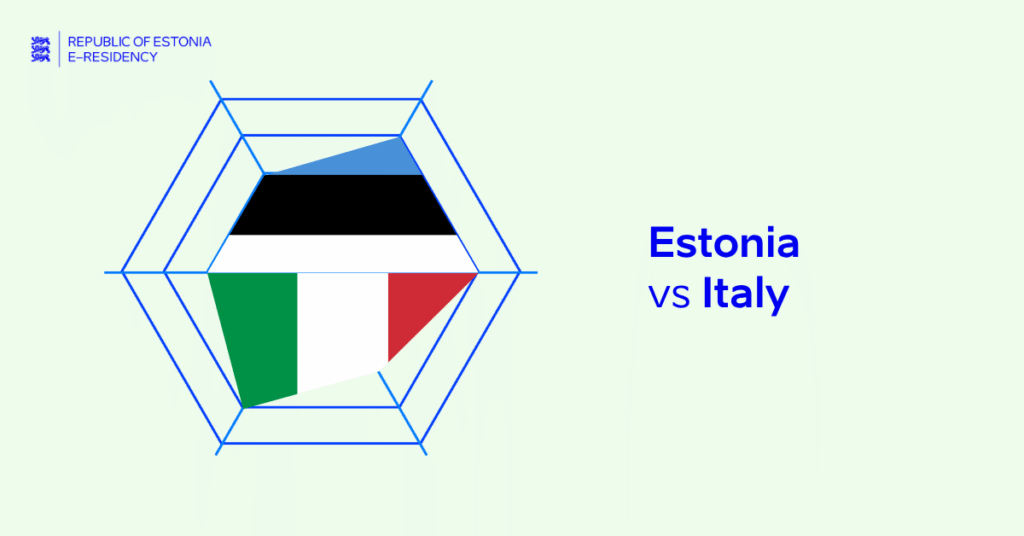
Founders are always on the hunt for the best place to set up their businesses in Europe, and with good reason. They are spoilt for choice, with a number of good options available even if they do not want to live in the country where their business is based. One emerging option is Italy, which saw a 25% growth in its startup ecosystem in 2025, climbing three places to 25th in the StartupBlink Global Ecosystem Index.
If you’re considering setting up a business in Italy, there are a number of potential pros and cons to consider. You’ll also need to compare it with other options available to you, such as Estonia, which ranks 12th on the Ecosystem Index – 13 places above Italy. In this article, we’ll go through the key points for setting up a company in Italy, and compare it with doing the same in Estonia through the e-Residency programme.
How to start a business in Italy as a foreigner
If you’re interested in setting up a business in Italy, the good news is that it’s open to EU and non-EU founders alike. The process does differ however depending on your situation.
EU citizens can register a company on the same terms as Italian nationals. Non-EU founders need to check whether their country has a reciprocity agreement with Italy – meaning Italy will only allow you to set up a company if Italian citizens can do the same in your home country. If you plan to manage the business from Italy, you will also need a visa or residence permit.
Choose a company structure
Wherever you are from, the first step is choosing the right company structure. These are the most likely options for founders looking into how to start a business in Italy.
- SRL: The equivalent of an LLC or an Estonian OÜ (private limited company), but with a €10,000 minimum share capital requirement. It also requires a notary.
- SRLS: A simplified version of the SRL, but with just a €1 minimum for share capital, fixed articles of association, and no notary fees. It’s a good choice for simple low-cost setups.
- Ditta individuale: This is the equivalent of a sole trader business, and is the simplest option. There’s no share capital needed, but you’ll have unlimited personal liability. It’s a good choice for freelancers.
Registering a company in Italy
This process depends on your chosen structure. For a Ditta individuale, you register with the Chamber of Commerce, get a Partita IVA from the tax authority, and enrol with INPS for social security. The Partita IVA is a VAT and tax identification number, required for all business activity in Italy.
For an SRL or SRLS, you need to formalise the incorporation deed in front of a notary. The notary then certifies the articles of association, shareholder structure, and registered office. You then register with the Business Register at the Chamber of Commerce, and obtain Partita IVA.
You do not actually have to travel to Italy to do this, as the incorporation can be completed through a notarised and apostilled power of attorney.
Incorporation typically takes two to four weeks. The total incorporation costs typically start at around €2,820, with average first-year costs around €5,650.
Company registration overview in Estonia
The process for registering an OÜ (private limited company) in Estonia through e-Residency is simpler. You sign up for an e-Residency digital ID card, and then register your company through Estonia’s Company Registration Portal. The process takes an average of just two hours.
The state registration fee is €265, with first-year costs from around €615, covering registration, your e-Residency card, and a mandatory registered address and contact person service. Everything from signing documents to filing annual reports is handled digitally using your e-Residency card.
Common challenges for entrepreneurs in Italy
A crucial challenge for founders in Italy is the country’s infamous bureaucracy. One report suggests Italian businesses spend as much as €57 billion each year to comply with red tape – with SMEs bearing the brunt.
Processes that might take days elsewhere can take weeks, and foreign documents must be translated into Italian and officially apostilled before submission, which adds time and cost before you even begin.
Opening a business bank account often requires a personal visit from the director, and non-Italian founders can face additional hurdles. On top of that, Italy's tax system is relatively high-burden, with complex rules meaning most founders will need to hire an accountant who knows how it all works.
Important considerations: tax residency, permanent establishment and “esterovestizione”
If you register a company in Italy but manage it from abroad, there are some important tax considerations to be aware of.
First is what is called a permanent establishment. If your business has a fixed place of operations in Italy such as an office, staff or regular activity, Italy may treat it as a permanent establishment, making the income generated by that activity taxable there, even if you are managing the company from a different country.
Second, esterovestizione, or "foreign dressing." This applies if you register a company outside Italy, but actually run it from Italy. Italian authorities can treat it as an Italian company for tax purposes if key decisions and management happen in Italy. A foreign registration alone is not enough to avoid Italian tax obligations.
Either way, if you are managing a company across borders, professional tax advice is essential before you make any decisions.
Company tax in Italy vs Estonia
Italy's standard corporate income tax (company tax) rate is 24%, applied to all taxable profits annually. A regional production tax (IRAP) of 3.9% also applies on top of this. Dividends distributed to shareholders are subject to a further 26% withholding tax.
In Estonia, corporate tax is 0% on retained profits. Tax only applies when profits are distributed, at a rate of 22%. For founders reinvesting in growth, this is a significant structural advantage.
Business banking in Italy vs Estonia
Opening a business bank account in Italy can be a slow process. Many traditional banks require in-person attendance and extensive documentation, and non-Italian founders can face additional scrutiny. Fintech options such as Qonto are more accessible for non-residents.
In Estonia, you can open a business account using an EU-licensed fintech such as Wise, with no travel required.
Italy vs Estonia: Company registration comparison
Italy vs Estonia: Company registration comparison
State registration fee
Time to register
Fully online registration
Local agent required
Average first-year costs
Corporate income tax
Dividend withholding tax
VAT rate
International Tax Competitiveness Index
Number of unicorns
E-services for businesses
Italy
€2,820
5–6 business days
Partial – notary required for SRL/SpA
No (but notary involvement mandatory)
€5,650
24% IRES on annual taxable profits + 3.9% IRAP regional tax
26% for individual shareholders
22% standard (reduced rates available)
37th
9
Partial – some processes require in-person visits
Estonia
€265
~2 hours
Yes
No
€1,295
0% on reinvested profits; 22% corporate income tax only when profits are distributed
No separate tax in most cases; corporate income tax is paid at the company level upon distribution
24% standard (VAT registration threshold: €40,000 annual taxable turnover)
1st
10
Yes – fully digital
State registration fee
Italy
€2,820
Estonia
€265
Time to register
Italy
5–6 business days
Estonia
~2 hours
Fully online registration
Italy
Partial – notary required for SRL/SpA
Estonia
Yes
Local agent required
Italy
No (but notary involvement mandatory)
Estonia
No
Average first-year costs
Italy
€5,650
Estonia
€1,295
Corporate income tax
Italy
24% IRES on annual taxable profits + 3.9% IRAP regional tax
Estonia
0% on reinvested profits; 22% corporate income tax only when profits are distributed
Dividend withholding tax
Italy
26% for individual shareholders
Estonia
No separate tax in most cases; corporate income tax is paid at the company level upon distribution
VAT rate
Italy
22% standard (reduced rates available)
Estonia
24% standard (VAT registration threshold: €40,000 annual taxable turnover)
International Tax Competitiveness Index
Italy
37th
Estonia
1st
Number of unicorns
Italy
9
Estonia
10
E-services for businesses
Italy
Partial – some processes require in-person visits
Estonia
Yes – fully digital
All figures 2025–2026
Where is best for you? Italy or Estonia
Both are European Union members, and both have strong startup scenes – but where they really differ is in ease of doing business. Here’s a look at which option could be best for your needs.
Why set up a company in Italy
- Your business is primarily Italy-facing, with Italian clients or operations
- You want direct access to Italy's domestic market and consumers
- You plan to relocate to Italy and manage the business in person
- You want to tap into Italy's growing startup ecosystem and funding networks
Why set up a company in Estonia
- Your business is location-independent or internationally focused
- You want to reinvest profits without triggering corporate tax
- You want a fully digital company you can manage from anywhere
- You want a simpler, lower-cost setup with minimal ongoing administration
- You want access to the EU single market without the complexity of Italian bureaucracy
Become an e-resident of Estonia
More from e-Residency
- Sign up for our newsletter
- Watch fresh video content - subscribe to our Youtube channel
- Meet our team and e-residents - register for our next Live Q&A