
how to invest in startups: lessons from two business angels
Low barriers to entry, an approachable ecosystem, digitisation and active business angel networks are just a few reasons angel investors flock to Estonia.
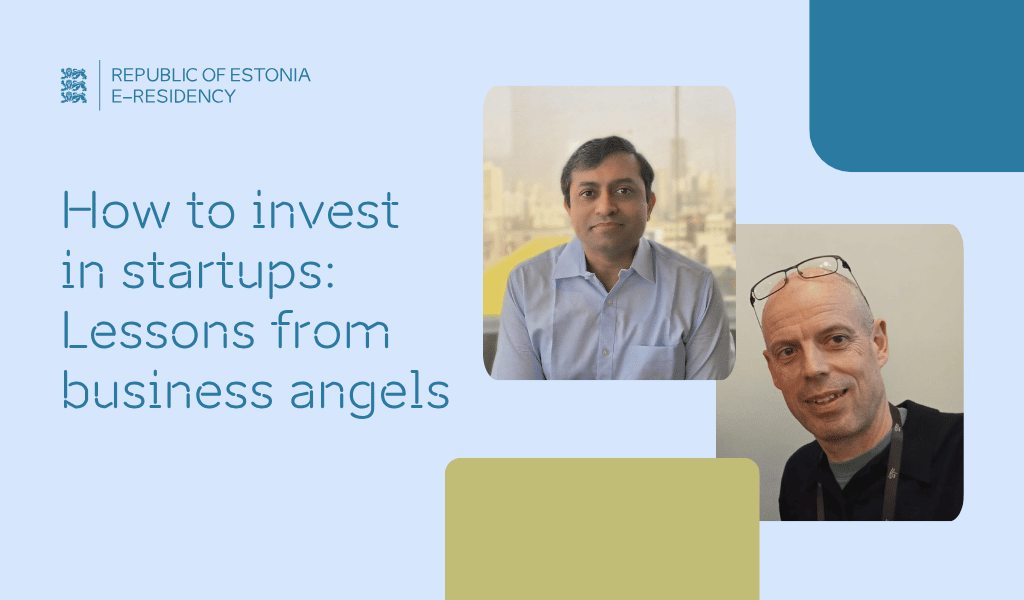
Business angels. The term conjures up images of friendly investors descending from the clouds to help any startup realise its wildest dreams. But for Philip and Hari, two angel investors who also happen to be e-residents, it's Estonia that seems like it was made in heaven.
"In London, it's not so easy to have such access," says Philip, who works as a lawyer for a UK communications regulator. "If I go down to Shoreditch and say, 'I want to invest in startups,' they will tell me that they have VC funds from the city putting in hundreds of thousands of pounds. How is little old me ever going to be involved in that?"
But in Estonia, as Philip has learned, the ticket sizes are smaller, syndicate investments are encouraged, efficiency is the rule, ideas abound, and there's plenty of support for investing in startups. He can also invest remotely from the UK, thanks to his e-Residency card and Estonian business, and given the country's startup culture, many of the details have been standardised.
This has made it an ideal place for him to get started as a business angel.
"What I like about Estonia is that everything's been figured out," says Philip, who has been investing in Estonian startups since 2024. "It's all about the most efficient way of doing things."
Becoming a business angel
Business angels or angel investors are individuals who choose to invest in startups before they might qualify for bank loans or venture capital funding. Often they acquire a stake in a company via their investment.
According to Philip, he eased his way into investing in different ways. He started out by investing in smaller, stock market-listed companies in the UK, often on its alternative investment market. He still invests in a few larger UK companies that pay dividends. "That is very low risk, but it has left me with space to try out startup investments in Estonia," says Philip.
Estonia entered the picture for Philip through his interest in marathon running. Fellow runners brought him into touch with Estonia, as well as an article in Wired magazine that described its hassle free, all-digital business ecosystem.
His curiosity led him to apply for e-Residency and, eventually, to learn how to invest in startups. While he had some investment experience, he was unprepared for the welcome he got from the Estonian Business Angel Network (EstBAN).
Invest in startups with e-Residency
1
Become an e-resident
Apply online and pick up your ID card at 50+ locations around the world.
Apply now
2
Research the landscape
Check out resources like e-Estonia, Startup Estonia, and the e-Residency blog.
Explore Estonia3
Open an Estonian company
Register a company 100% online in just hours. Use it as a holding company or SPV (Special Purpose Vehicle).
Read about SPVs4
Join investor networks & events
Contact EstBAN (Estonian Business Angels Network) to join syndicates. If you like, attend in-person events like Latitude59 and sTARTUp Day.
Browse events5
Build your startup portfolio
Start small, and benefit from 0% corporate income tax on reinvested profits. Sign contracts securely and remotely.
Read our article6
Outsource admin
Let trusted service providers in the e-Residency Marketplace handle accounting, banking and more.
Browse Marketplace
How to start investing in startups
Reaching out to EstBAN proved to be the number one move in his investment journey, and it's that reliance on syndicates that also helped Hari, the founder of UAE-based Havenn Investments, to become an Estonian business angel.
Join a business angel network and syndicates
"As far as choosing investments goes, I personally go with syndicates," says Hari.
By joining forces with a business angel network early on, Hari says he was able to get advice on how to get started, while also protecting himself from bad investments. Syndicates also have lead investors who help to clarify the investments to those just getting started, he notes, as well as to carry out the necessary due diligence.
Taking part in a syndicate can also be a stepping stone toward being better at evaluating startups, Hari adds. "Something I am still a beginner of, as of now."
Attend pitching competitions and startup events
Philip agrees. In fact, it was at an EstBAN organised pitching competition where he learned how to invest in startups. It also opened his eyes to the investment opportunities possible in Estonia. Both praised their relationship with EstBAN, which organises meetings, seminars, and other events that help first-time business angels get acquainted with the Estonian ecosystem.
"In the UK, people tend to think 'I’ll get a job' rather than 'my first thing in life will be to start a business,'" he says. "This kind of thinking isn't as common."
It was at that event where Philip first learned about KULG, a running app that helps runners and coaches train smarter and run better. This would become his first investment.
Hari also got started by attending startup pitching competitions, either in person or virtually. More of such competitions were taking place online when he got started, around the time of the COVID-19 pandemic.
Mentor and get involved in your investments
For Philip, investing in KULG was a straightforward, standardised process. He notes that Estonia is an EU country, making it a part of the single market. "It has common rules that help startups build their businesses," he says.
Philip didn't only invest in KULG, he became a user of the app, providing feedback to its Estonian founders, and serving as a sounding board for new ideas.
"It's been a learning experience," Philip says of becoming a business angel. "But you never know until you try."

How to start building a portfolio
According to Hari, he got started investing in startups in Estonia out of a desire to invest and build a portfolio at a smaller, targeted scale.
In other European countries, larger minimum tickets were expected of around €50,000. But Hari was looking for an environment where he could ease into the process, learning as he went. Estonia offered him that opportunity.
"I wanted a 'learning-by-doing' approach with smaller investments," says Hari. "Through a friend, I was introduced to Estonia and connected with e-Estonia, Startup Estonia, and EstBAN."
For Hari, becoming an angel investor went hand-in-hand with becoming an Estonian e-resident. He obtained his card just before the pandemic at a time when the world was moving to remote work. It has allowed him to set up his company without being physically in Estonia, manage his investments remotely, avoid frequent currency conversions and forex losses, and time his investments more flexibly, he says.
"It also reduced administrative friction," Hari is keen to point out, "because I can use service providers to handle taxes, accounting, and compliance."
Hari also uses Estonian-founded fintech Wise to set up an account and invest in startups.
What to look for in a startup investment
According to Philip and Hari, no two angel investors are alike and each is looking for something different. Philip invested in KULG, for example, because he liked the app and its team and it was connected to his personal hobby.
He has also since taken part in syndicate investments during the annual sTARTUp Day event held in Tartu. Philip calls his own measured approach ‘focus investing’.
"I prefer to focus on just one or two companies," Philip says. "If it doesn't work out, then it doesn't work out," he adds. "Put your eggs in one basket and then watch that basket carefully."
Hari, as noted, also takes part in syndicate investments. Like Philip, he also likes to feel some affinity for the team, particularly at the early stages when companies have no track record. But Hari underscored that, by participating in syndicates, one can reduce "risk perception," as other investors offer a "psychological buffer," a form of protection from being carried away by an idea.
His first investment was in the Latvian digital banking startup Jeff App, which received EstBAN backing at sTARTUp Day in 2020. In general, Hari describes himself as sector agnostic, but says he is attracted to companies with sustainable, scalable solutions led by trustworthy teams.
"I avoid chasing hype cycles like AI or fintech unless there is long-term substance," he adds.
But one should be prepared to be impressed, notes Philip. "Estonia has excellent tech," he says. "I think the coding skillset is world class."
Investing in startups in Estonia
Another influence on Philip and Hari's investment decisions has been Estonia itself.
Hari sees Estonia as a kind of sandbox, where he can learn the ropes as an investor without making risky and large first-time investments. He also cites the country's lack of a corporate tax on reinvested profits as an aspect that is favorable to startup investors like him.
"That makes a big difference for people who want to come and test ideas, start companies, or invest," he says. "Corporate tax is something people consider when choosing where to set up," he adds. "It allows people to experiment first and decide later whether something works."
He also sees Estonia's do-it-yourself ethos as a positive as an investor, describing the country as being more flexible and adaptive in its business culture. "The mindset is more about modifying systems to make them work efficiently rather than preserving tradition," he notes.
Philip agrees. "The ethos is about simplifying things and removing inefficiencies," he says. He also appreciates the directness of Estonian communication, which makes it easier for him to communicate with other investors and businesses. Originally from Edinburgh, Philip says that Scots are also just as direct, and he values how approachable people in the startup sector are.
"The impression I get is that people are pretty genuine," says Philip. "There may be a hundred reasons why the startup might not succeed, but it's not because they are not genuinely trying."
Learn more about ways to invest as an e-resident of Estonia:
Please to watch this video.
Advice for aspiring business angels
But even if the team is good and the science is sound, that doesn't mean that all investments will turn out well.
- Monitor global events: Business angels everywhere have had to grapple with the after effects of the pandemic, plus the Russian invasion of Ukraine and multiple ongoing conflicts in the Middle East. "One major lesson I've learned is that global politics and external shocks can affect startups in unexpected ways," Hari says. "Even if the idea is good, external conditions can force companies to shut down." He advises any would-be angels to pay attention to larger events.
- Acknowledge risk: Philip says that investors should acknowledge that any investment comes with risk, and they might not get their money back. Fortunately in Estonia, though, one can learn the hang of things by taking part in syndicates and with support in place, such as via EstBAN, to help investors.
- Attend local events: What both of them recommend to would-be business angels is to visit the country if they have the chance to take part in the sTARTUp Day or Latitude59 conferences. "My advice would be to go for it," says Philip. "While you can do it all remotely, it's useful to go there, meet people, and attend these conferences," he says. Meeting people in person helps to build networks and trust.
- Get to know the region: Hari advises visiting not only Estonia, but the entire Baltic and Nordic region to understand how interconnected it is. "I would say, visit Estonia to understand the ecosystem before investing in startups, and consider setting up a company if you are investing regularly," he says.
As for Philip, he will be back as soon as September to take part in the Tallinn Marathon, and to visit the KULG team. "It's just a nice race," he says. "For me, this has always been a learning experience. I meet interesting people and that is another reward of investing."
Invest in startups with e-Residency
More from e-Residency
- Sign up for our newsletter
- Watch fresh video content - subscribe to our Youtube channel
- Meet our team and e-residents - register for our next Live Q&A